How much of the receptor does psilocybin need?
A Danish brain-imaging study measured how many serotonin 2A receptors psilocybin occupies, and how that matched what people felt.
 By Marlin Charmil · · 5 min read
It is widely accepted that classic psychedelics act mainly through the serotonin 2A receptor. But for psilocybin, nobody had directly measured how much of that receptor is occupied in a living human brain, or how that tracks with the experience.
The study
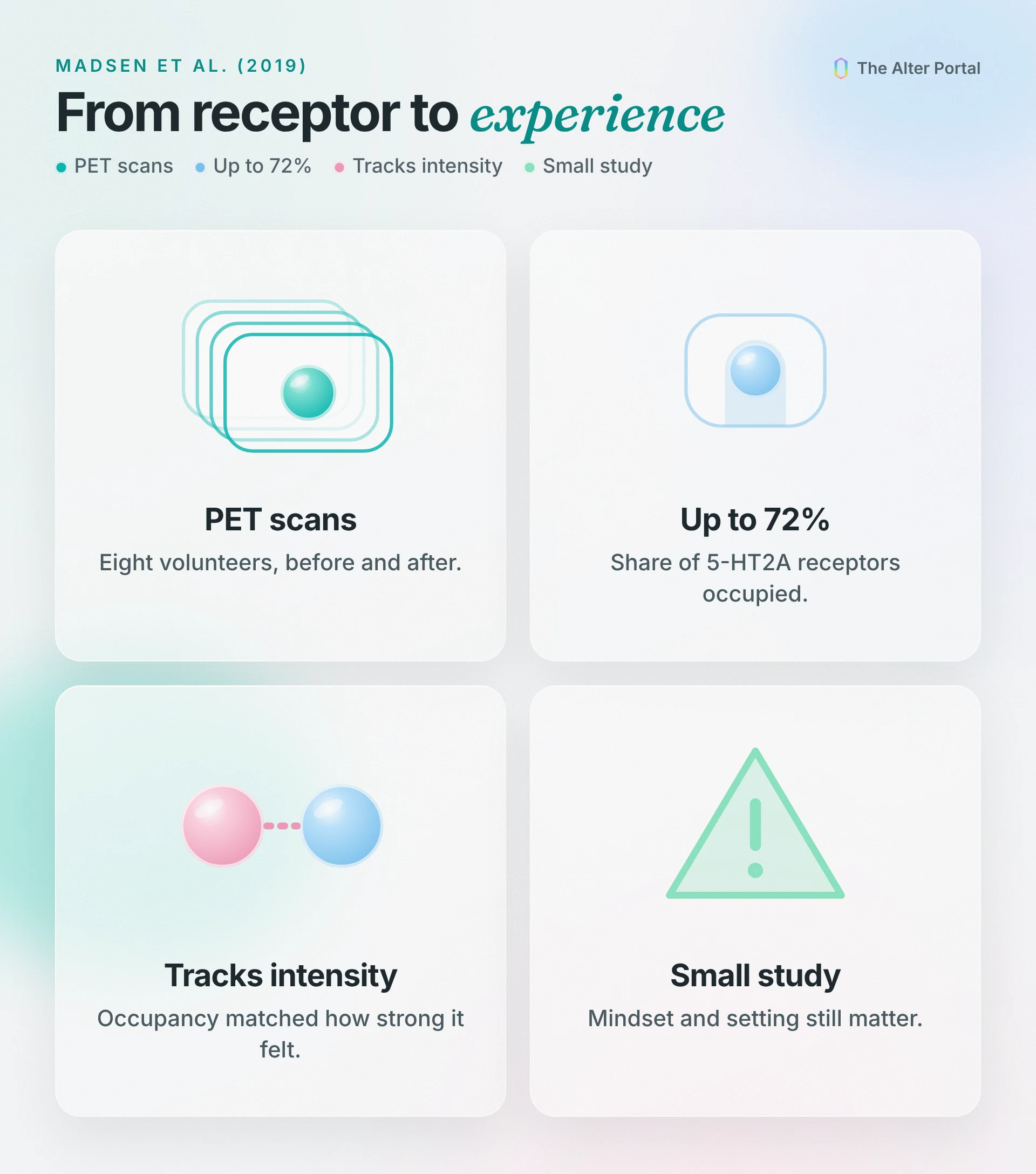
In 2019 Martin Madsen, Gitte Knudsen and colleagues in Copenhagen scanned eight healthy volunteers with PET, using a tracer that binds to serotonin 2A receptors [1]. Each person had a baseline scan and one or two more scans after taking psilocybin, while researchers measured psilocin, the active form, in their blood and asked how intense the experience felt [1].
What they found
Psilocybin occupied up to 72% of serotonin 2A receptors, in a dose-related way [1]. Both receptor occupancy and blood psilocin levels were closely linked with how intense people rated their experience [1]. Blood levels over time varied between people, but the level at any moment tracked the experience well [1].
Why it matters
This was the first direct human evidence connecting psilocybin, the receptor and the felt intensity in one study [2]. It supports the 5-HT2A story and may help researchers design treatments more precisely. With eight volunteers, it is a small study, and receptor occupancy is not the only thing that shapes an experience: mindset and setting still matter.
This article is educational. It is not medical advice and does not encourage anyone to take any drug.
The Alter Portal covers research and culture. Nothing here is medical advice or encouragement to use drugs. Read on the interactive site →