Psilocybin, nature and political views: a small, curious study
A small 2018 study found people felt more connected to nature after psilocybin therapy, and less drawn to authoritarian views.
 By Marlin Charmil · · 5 min read
Psychedelic experiences are often described as changing how people see the world. In 2018 Taylor Lyons and Robin Carhart-Harris at Imperial College London measured two specific outlooks: how connected people felt to nature, and where they stood between libertarian and authoritarian political views [1].
The study
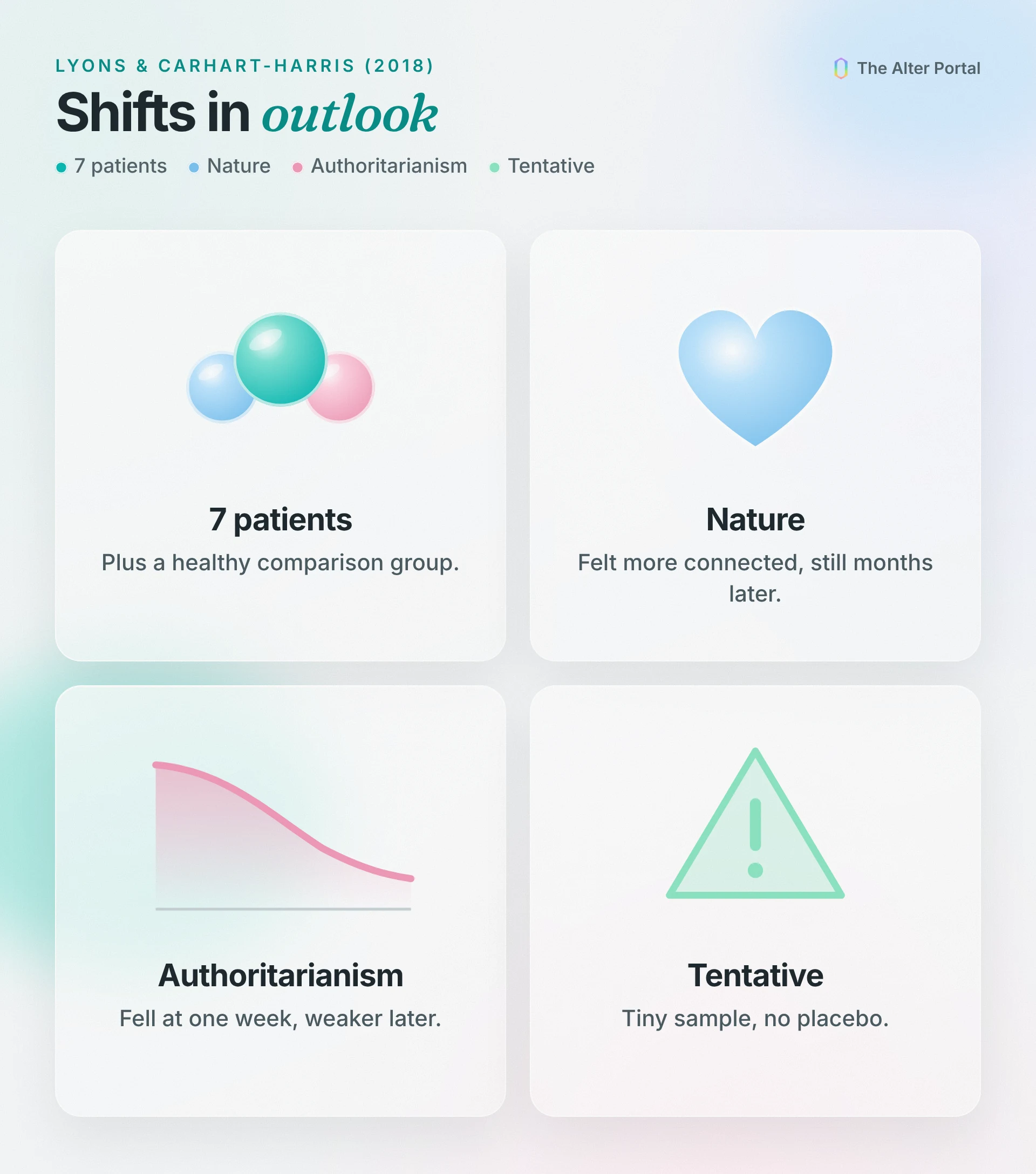
Seven patients with treatment-resistant depression received psilocybin as part of an open-label trial, and were compared with an age-matched group of healthy people who did not [1]. Participants filled in a nature relatedness scale and a short political perspective questionnaire [1].
What changed
One week after the sessions, patients’ nature relatedness had significantly increased and their authoritarian views had significantly decreased [1]. At 7 to 12 months, nature relatedness was still higher, and the drop in authoritarianism remained at a weaker, trend level [1].
Why to read this lightly
Seven patients is a tiny sample, there was no placebo, and political views are complex. The authors themselves describe the findings as tentative [1]. It is an intriguing hint about outlook, not evidence that psilocybin changes how anyone votes. Questions like this also raise ethical issues about how such effects should be talked about at all.
This article is educational. It is not medical advice and does not encourage anyone to take any drug.
The Alter Portal covers research and culture. Nothing here is medical advice or encouragement to use drugs. Read on the interactive site →