Is MDMA’s warmth just oxytocin?
MDMA raises levels of oxytocin, the so-called bonding hormone. But when scientists tested whether that explains its social effects, the answer was less simple.
 By Marlin Charmil · · 5 min read
MDMA is known for making people feel closer and more open towards others. A popular explanation is oxytocin, a hormone linked with bonding and trust. The idea has some support, but the full story is more complicated.
The first evidence in humans
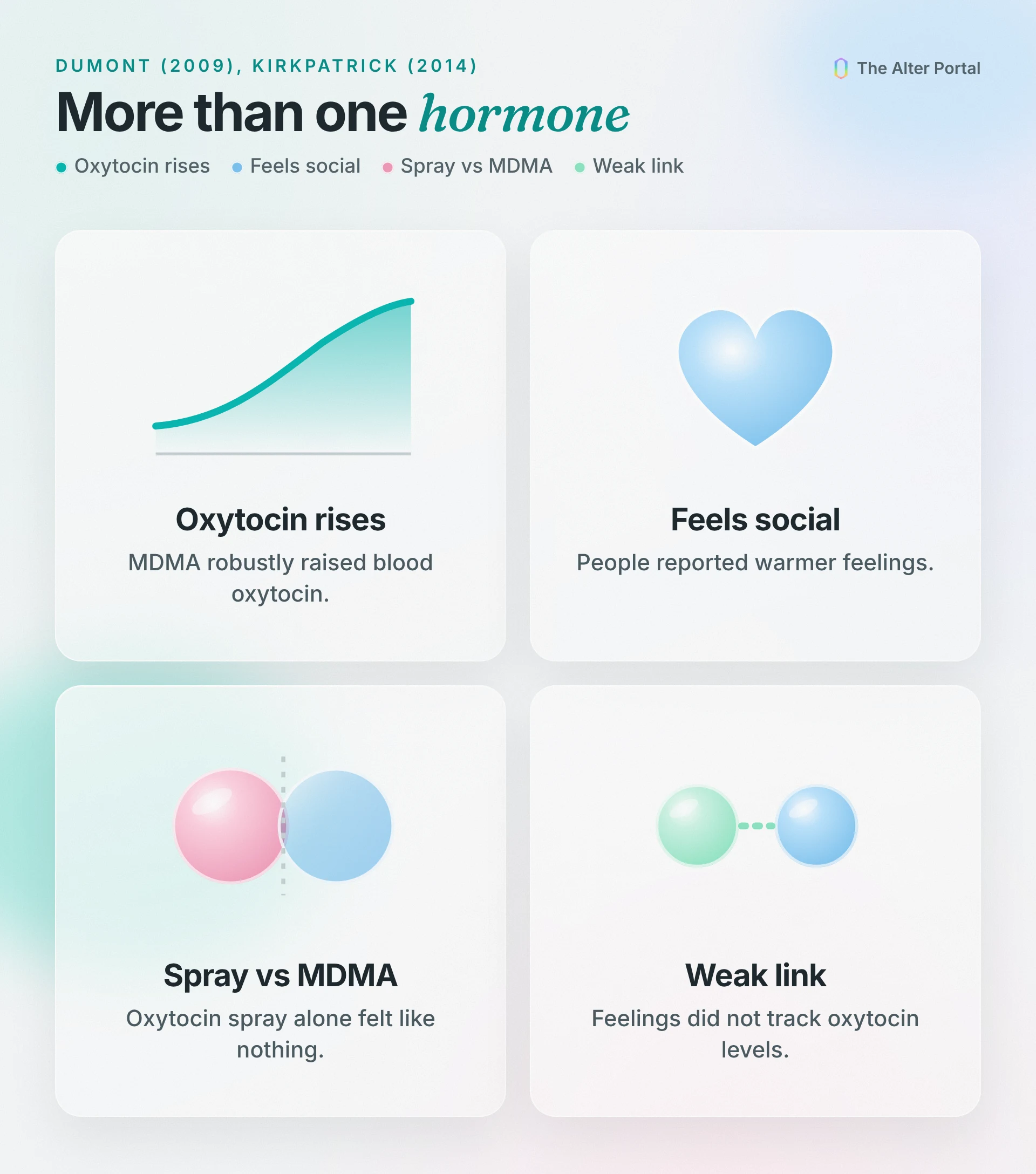
In 2009 Glenn Dumont and colleagues in the Netherlands ran a double-blind, placebo-controlled study in 15 healthy volunteers [1]. MDMA caused a robust rise in blood oxytocin and an increase in self-reported prosocial feelings [1].
A direct comparison
In 2014 Matthew Kirkpatrick, Harriet de Wit and colleagues in Chicago compared MDMA directly with oxytocin given as a nasal spray in the same people [2]. MDMA raised blood oxytocin more than the nasal spray did, and it increased euphoria and sociability, while oxytocin spray had no noticeable subjective effects [2]. People’s feelings on MDMA did not track their oxytocin levels [2].
A companion study concluded that the findings gave only limited support to the idea that oxytocin produces MDMA’s prosocial effects [3].
What this means
Oxytocin is probably part of the picture, but not the whole of it. MDMA also releases serotonin and other messengers, and those changes likely work together. It is a good reminder that “the love hormone” makes a catchy headline but rarely tells the whole story.
This article is educational. It is not medical advice and does not encourage anyone to take any drug.
- Dumont et al. (2009), Increased oxytocin concentrations and prosocial feelings in humans after ecstasy (MDMA) administration, Social Neuroscience
- Kirkpatrick et al. (2014), Plasma oxytocin concentrations following MDMA or intranasal oxytocin in humans, Psychoneuroendocrinology
- Kirkpatrick et al. (2014), A direct comparison of the behavioral and physiological effects of MDMA and oxytocin in humans, Neuropsychopharmacology
The Alter Portal covers research and culture. Nothing here is medical advice or encouragement to use drugs. Read on the interactive site →