Psilocybin and body dysmorphic disorder: a first pilot
Body dysmorphic disorder traps people in a distorted view of their own appearance. A small 2023 study tested whether psilocybin could loosen that grip.
 By Marlin Charmil · · 5 min read
Body dysmorphic disorder, or BDD, is an often severe condition in which people are preoccupied with flaws in their appearance that others barely notice or do not see at all [1]. Only two treatments, serotonin reuptake inhibitors and cognitive behavioural therapy, have been shown to work in randomised trials [1]. Many people are not helped enough by either.
The pilot
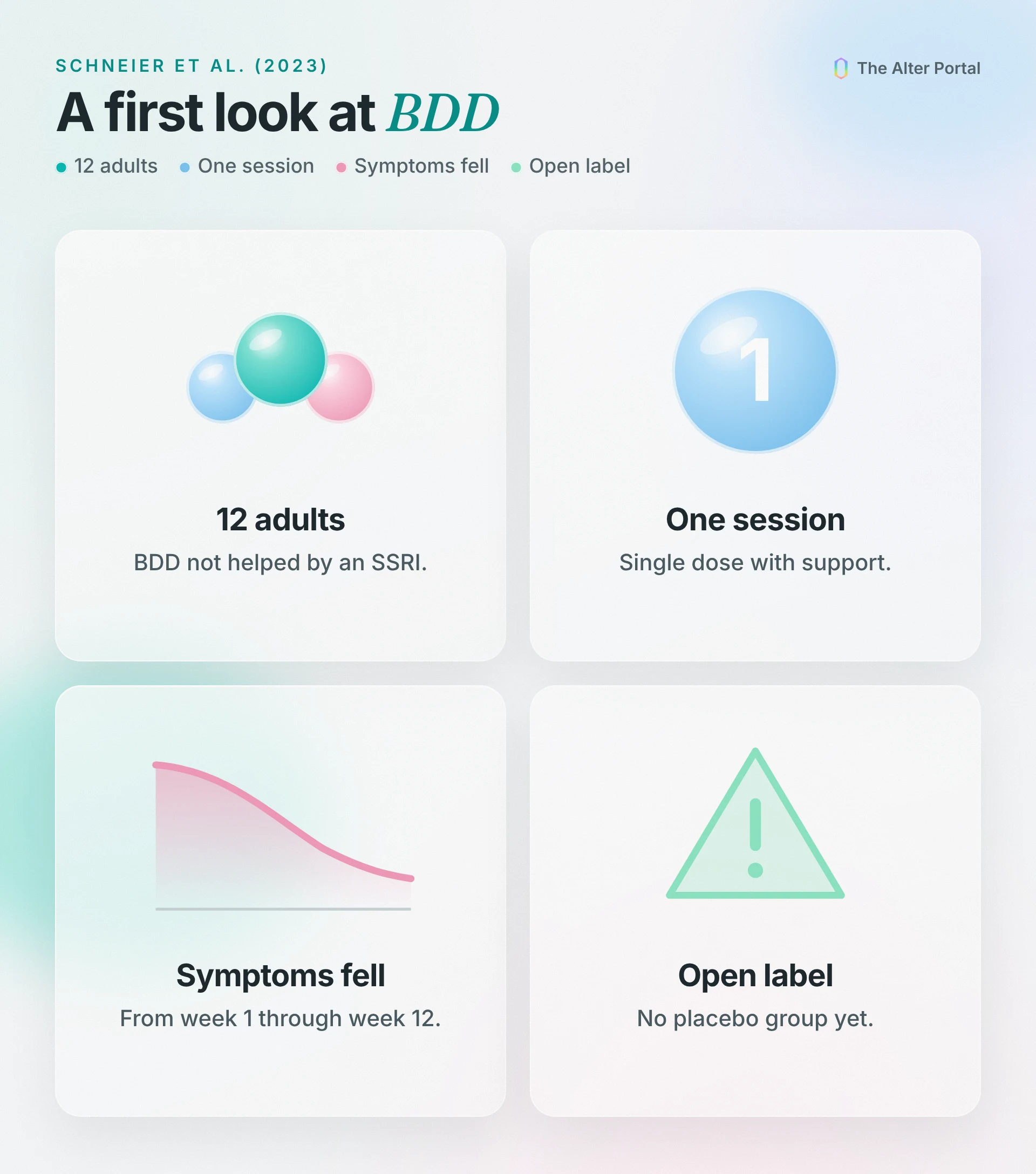
In 2023 Franklin Schneier and colleagues at Columbia and the New York State Psychiatric Institute ran an open-label trial in 12 adults with moderate to severe BDD that had not responded to at least one serotonin reuptake inhibitor [1]. Each received a single dose of psilocybin with psychological support before, during and after [1].
What changed
Symptom scores fell significantly over 12 weeks, with changes appearing in the first week and lasting through the end of follow-up [1]. At week 12, seven of the 12 participants, or 58%, met the threshold for a response [1].
Why caution is needed
There was no placebo group, so everyone knew they had received psilocybin, and hopes were high. Twelve people is a very small sample. The authors describe the results as preliminary support that warrants controlled trials [1]. If you are struggling with how you see yourself, talking to a professional is a good place to start.
This article is educational. It is not medical advice and does not encourage anyone to take any drug.
The Alter Portal covers research and culture. Nothing here is medical advice or encouragement to use drugs. Read on the interactive site →