The odd legal gap: mushrooms and the 1971 UN treaty
Psilocybin is in the strictest category of the main UN drug treaty. Yet the mushrooms themselves are not. Here is how that happened.
 By Marlin Charmil · · 5 min read
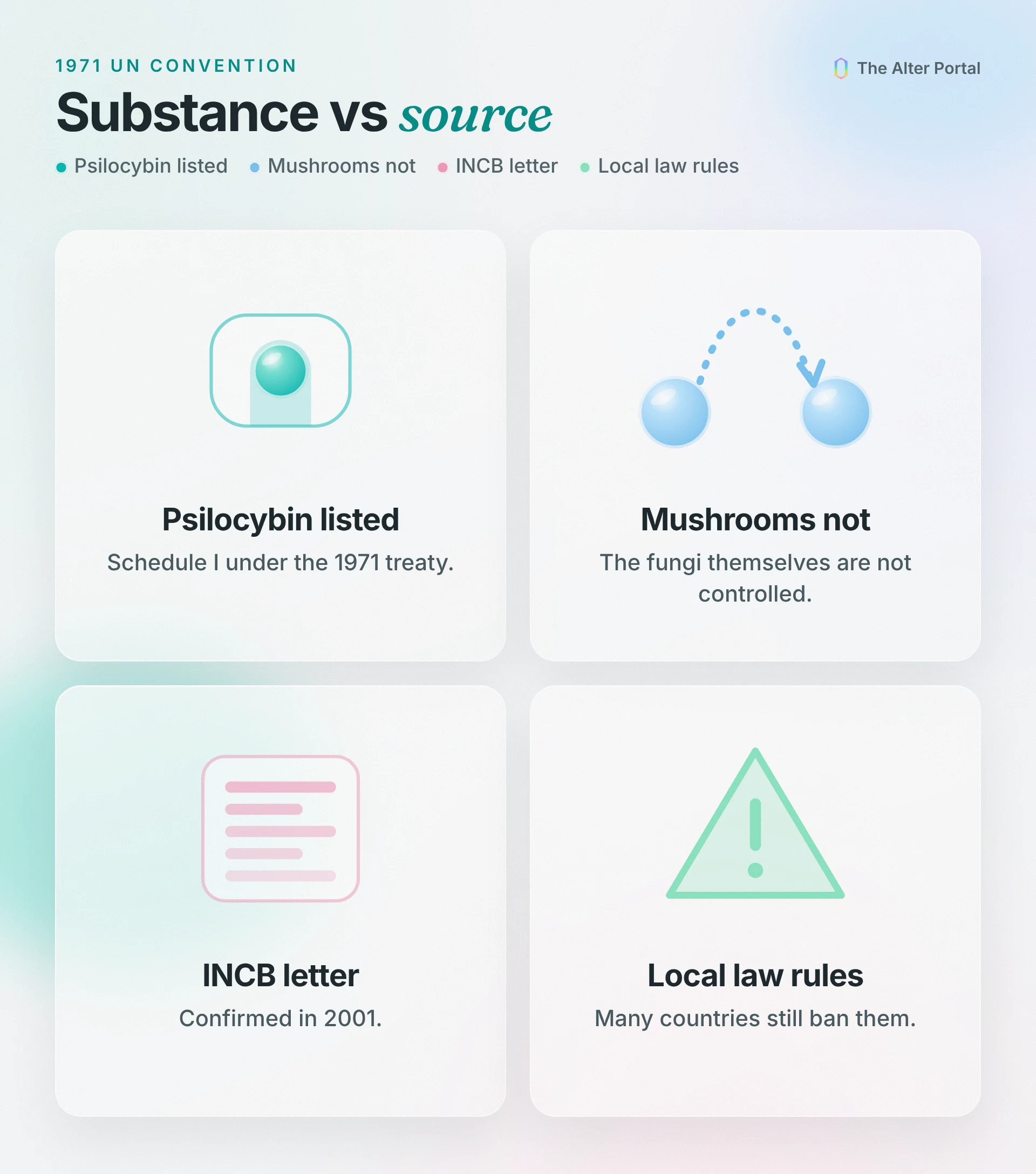
The 1971 UN Convention on Psychotropic Substances is one of the treaties that shapes drug law worldwide. It lists LSD, mescaline, DMT and psilocybin in its strictest category, Schedule I [1].
But not the plants
The official commentary on the treaty makes clear that the plants and fungi containing these substances are not themselves controlled. That includes peyote and Psilocybe mushrooms [1]. In 2001 the International Narcotics Control Board confirmed this in a letter to the Dutch health ministry: as a matter of international law, no plants or mushrooms containing psilocybin or psilocin were controlled under the 1971 Convention [2].
National law still decides
The same letter stressed that criminal cases are decided under each country’s own law [2]. In practice many countries do ban psilocybin mushrooms, and growing or selling them is a serious offence in much of the world. The treaty gap explains why places like the Netherlands could handle truffles differently, not that mushrooms are legal everywhere.
Why it matters now
Policy researchers point to this gap as one reason some countries have room to regulate plant-based psychedelics without breaking the treaties [1]. For readers, the lesson is simple: always check the law where you are. Our guide Psychedelics and the law explains more.
This article is educational. It is not medical advice and does not encourage anyone to take any drug.
The Alter Portal covers research and culture. Nothing here is medical advice or encouragement to use drugs. Read on the interactive site →