Ketamine vs ECT: the biggest head-to-head trial
Electroconvulsive therapy has been the strongest option for severe depression for decades. A 403-person trial compared it with ketamine.
 By Marlin Charmil · · 5 min read
Electroconvulsive therapy, or ECT, has been used for severe depression for more than 80 years and is often seen as the most effective option when other treatments fail [2]. It can also affect memory, needs anaesthesia and carries stigma. Ketamine, given by infusion, is another option, but the two had never been compared at scale.
The trial
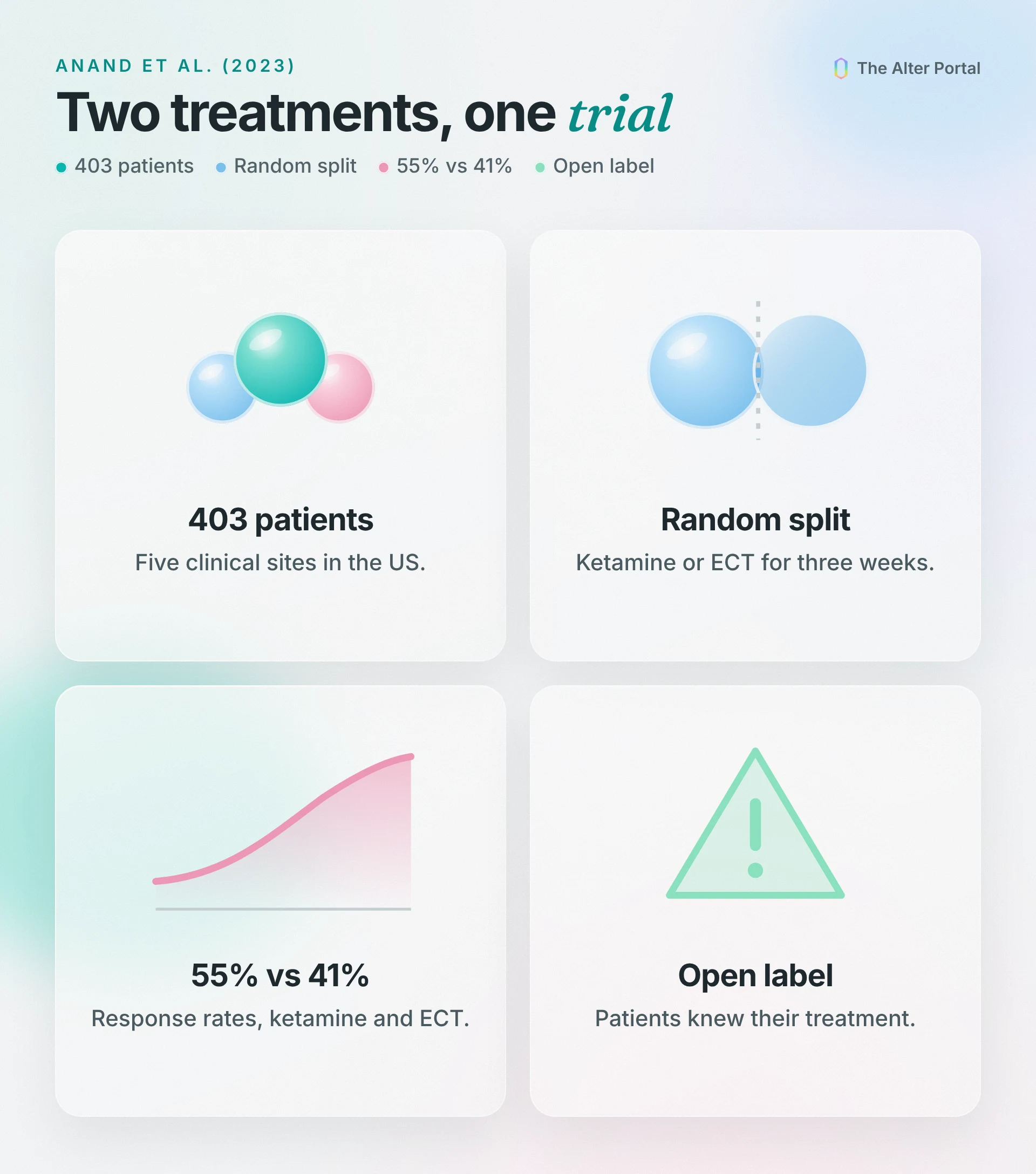
In 2023 Amit Anand and colleagues published an open-label randomised trial in the New England Journal of Medicine [1]. 403 patients referred to ECT clinics for treatment-resistant depression without psychosis were randomly assigned to ketamine or ECT across five sites [1]. Treatment ran for three weeks [1].
The result
About 55% of people in the ketamine group responded, compared with about 41% in the ECT group, meeting the bar for ketamine being “noninferior” [2]. ECT was linked with muscle and joint side effects, while ketamine was linked with dissociation [1]. The study also tracked memory, which is a major concern with ECT [2].
What to keep in mind
The trial was open-label, so patients knew which treatment they received. It excluded people with psychotic depression, a group for whom ECT is especially used. And “noninferior” means ketamine was not meaningfully worse, not that it replaces ECT for everyone. For people who cannot or do not want ECT, though, it strengthens the case for a real alternative.
This article is educational. It is not medical advice and does not encourage anyone to take any drug.
The Alter Portal covers research and culture. Nothing here is medical advice or encouragement to use drugs. Read on the interactive site →