Inside a DMT brain: what EEG and fMRI saw at once
A 2023 study scanned people’s brains with two methods at the same time while they were on DMT. The brain did not quieten down. It talked to itself more.
 By Marlin Charmil · · 6 min read
DMT is famous for producing one of the most intense and immersive experiences of any psychedelic, while people stay fully awake. That makes it a useful, if extreme, window onto how the brain builds conscious experience.
In 2023 a team at Imperial College London scanned 20 healthy volunteers with EEG and functional MRI at the same time, before, during and after an intravenous dose of DMT, and on a separate day with placebo [1]. Combining the two methods let them see both the brain’s fast rhythms and where in the brain the changes happened [1].
What changed
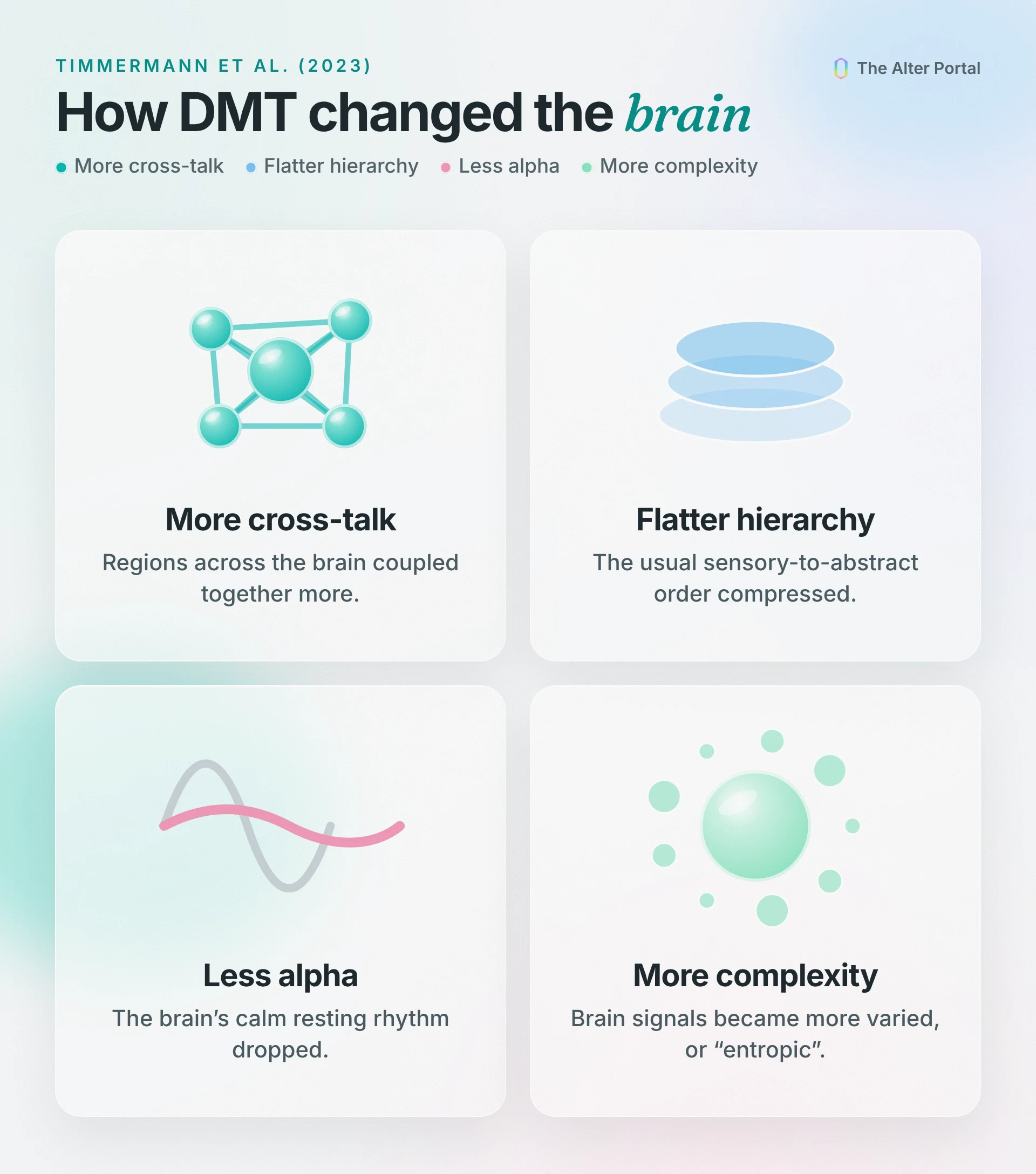
Under DMT, the fMRI showed a strong rise in global functional connectivity, meaning that regions across the brain became more coupled with each other [1]. Networks that normally stay distinct became less separated, and the brain’s usual hierarchy, from basic sensory areas up to abstract “higher” areas, was compressed [1].
These changes lined up with the EEG: as connectivity rose, alpha rhythms dropped and the signal became more complex, or “entropic” [1].
Where it happened
The areas that changed most overlapped with maps of serotonin 2A receptors from separate PET studies, and with regions linked to distinctly human abilities such as language and imagination [1]. That fits the idea that DMT acts most strongly on the brain’s most evolved, integrative areas.
What it does not show
This was a small study in healthy volunteers, and correlations between brain maps and experience are not proof of how one causes the other. But it is one of the most detailed views yet of a brain in a fully psychedelic state.
This article is educational. It is not medical advice and does not encourage anyone to take any drug.
The Alter Portal covers research and culture. Nothing here is medical advice or encouragement to use drugs. Read on the interactive site →