Psilocybin and bipolar II depression: a careful first look
People with bipolar disorder have been kept out of psychedelic trials for decades. A small 2023 study tested whether that needs rethinking.
 By Marlin Charmil · · 5 min read
For years, psychedelic trials have screened out people with bipolar disorder, largely out of concern that a strong experience could trigger mania. That leaves a group with hard-to-treat depressive episodes with very little evidence either way.
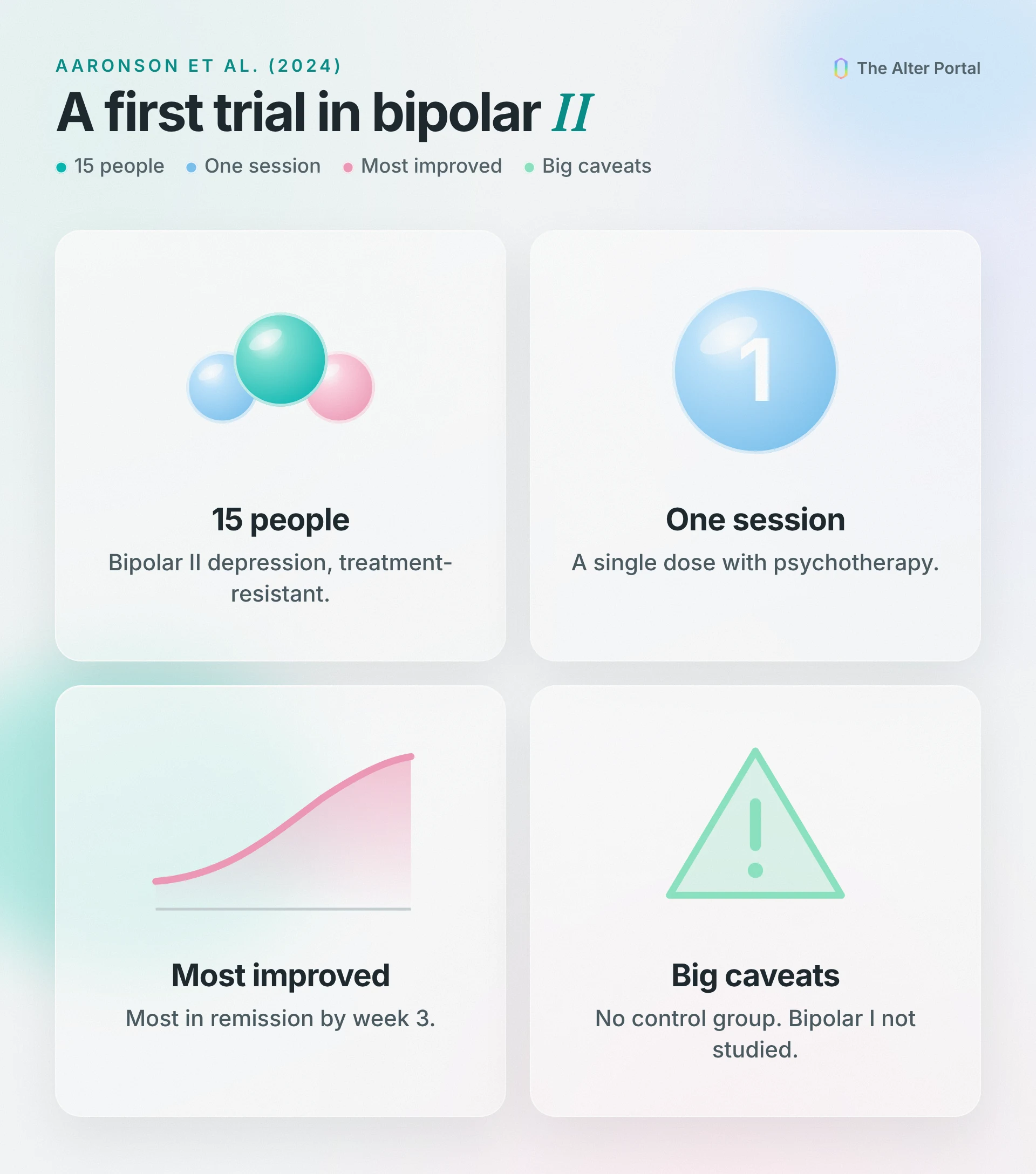
In 2023 Scott Aaronson and colleagues at Sheppard Pratt in Baltimore ran a small open-label trial of a single dose of psilocybin, with psychotherapy, in 15 adults with bipolar II disorder whose depression had not responded to treatment [1]. People had to be off their usual mood medications to take part [1].
What they found
Three weeks after the single session, most participants met criteria for remission on a standard depression scale, and most were still in remission at 12 weeks [1]. The researchers did not see an increase in mania or hypomania symptoms, or in suicidality [1].
Why caution still matters
There was no control group, so everyone knew they were receiving psilocybin, and expectation can play a big role. The group was small and carefully selected. Bipolar I disorder, where mania is more severe, was not studied at all. The authors present this as a first step that supports more research, not as evidence that psilocybin is safe for everyone with bipolar disorder [1].
This article is educational. It is not medical advice and does not encourage anyone to take any drug.
The Alter Portal covers research and culture. Nothing here is medical advice or encouragement to use drugs. Read on the interactive site →