One dose, six weeks: the 104-person psilocybin trial
A 2023 trial gave 104 adults with major depression either psilocybin or a placebo that causes a skin flush. Here is what it showed, and what it could not.
 By Marlin Charmil · · 5 min read
Many early psilocybin studies were small or open-label. In 2023 Charles Raison and colleagues published one of the larger double-blind trials so far, run at 11 sites across the US [1].
The design
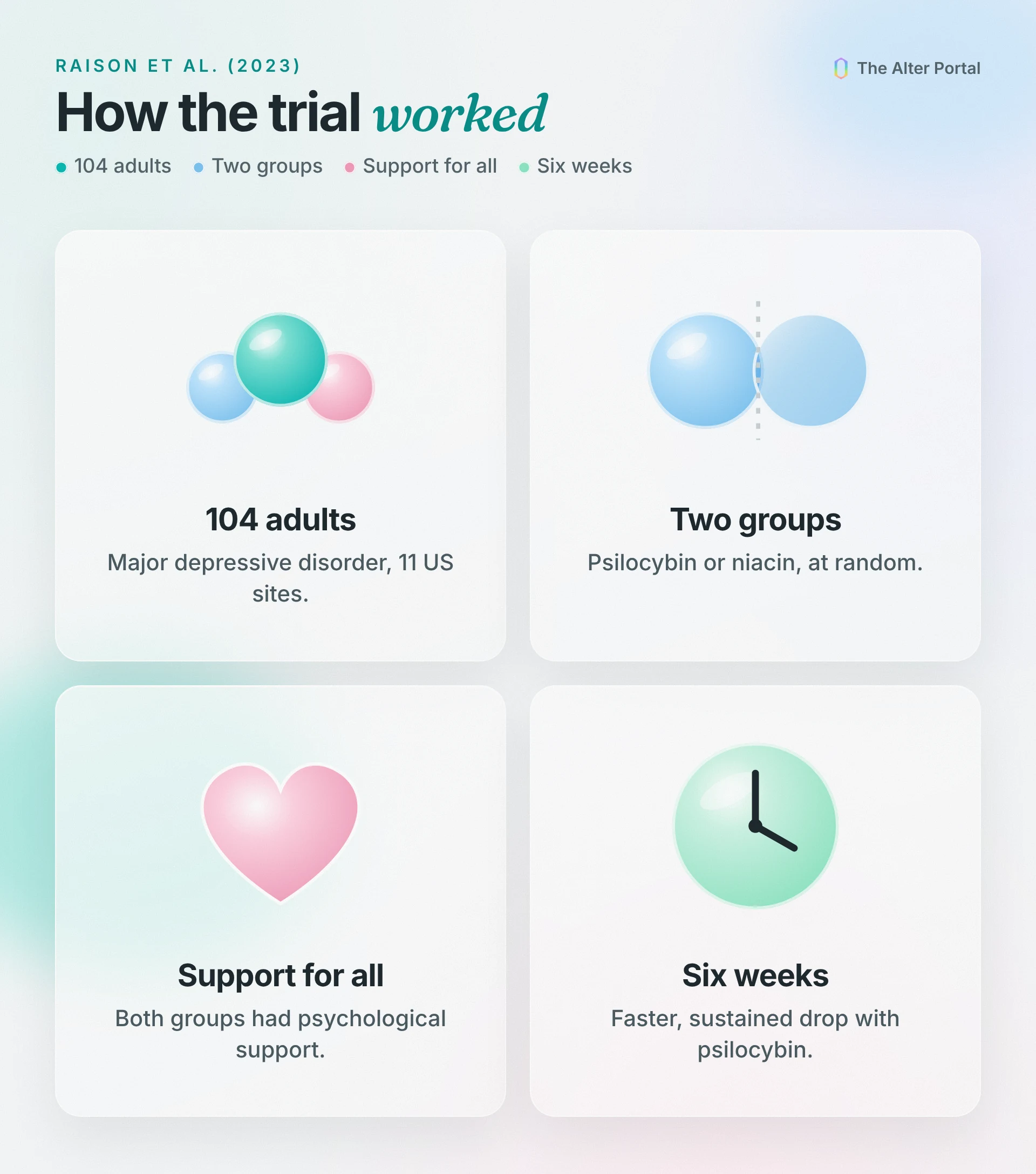
104 adults with major depressive disorder were randomly assigned to a single dose of psilocybin or to niacin, a vitamin that causes flushing and was used as an “active” placebo [1]. Both groups received psychological support [1].
The result
Psilocybin with support was linked to a rapid and sustained drop in depression scores over six weeks, compared with niacin [1]. It was generally well tolerated in this carefully screened group [1].
What to keep in mind
Six weeks is short for a condition that often lasts years. Psilocybin is hard to disguise, so many people can guess which group they are in, even with an active placebo. And participants were medically healthy adults who passed strict screening. The trial is a meaningful step, but larger and longer studies are needed before anyone can talk about a proven treatment.
This article is educational. It is not medical advice and does not encourage anyone to take any drug.
The Alter Portal covers research and culture. Nothing here is medical advice or encouragement to use drugs. Read on the interactive site →