Why some mushrooms are “magic”: the jumping gene cluster
Psilocybin turns up in mushrooms that are not closely related. Genetics suggests the recipe was passed between species.
 By Marlin Charmil · · 5 min read
Psilocybin is found in a scattered set of mushrooms that are not each other’s closest relatives. That pattern puzzled biologists. If the ability evolved once, why is it so spotty across the family tree?
A recipe in five genes
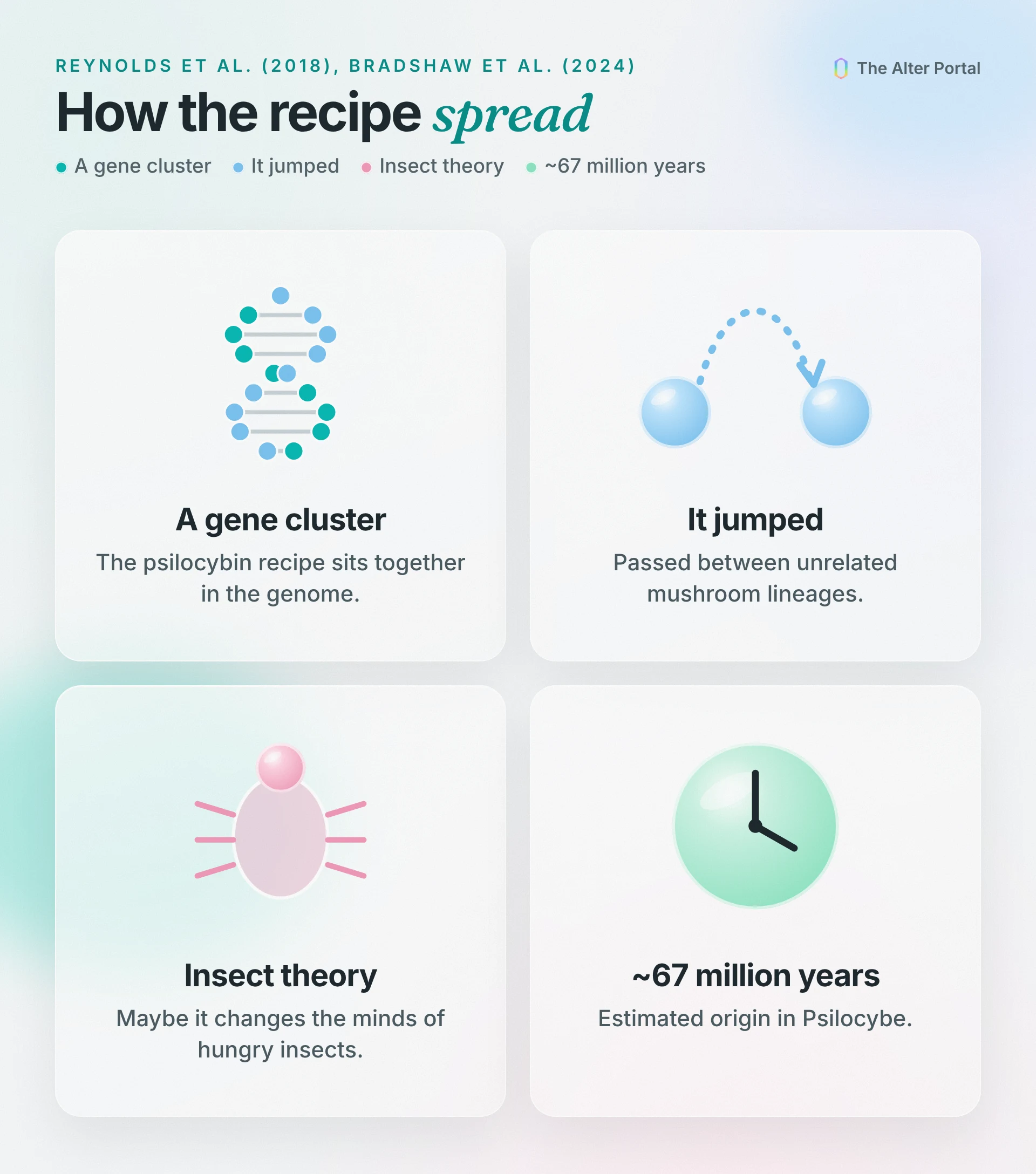
In 2018 Jason Slot and colleagues at Ohio State sequenced the genomes of three distantly related psilocybin mushrooms and compared them with mushrooms that do not make it [1]. They found a cluster of genes for psilocybin and evidence that it had been passed horizontally between fungal lineages, rather than only inherited from parent to offspring [1]. Press reports described it as a cluster of five genes shared by the psychedelic species [2].
Why make it at all?
The team noticed the cluster tends to appear in mushrooms living on dung and decaying wood, where insects compete for food. They speculated that psilocybin may have helped mushrooms by altering the behaviour of the insects that eat them [2]. This is a hypothesis, not a proven function.
An ancient origin
A larger 2024 study of the Psilocybe genus estimated that psilocybin production arose there around 67 million years ago, close to the extinction event that ended the age of the dinosaurs, with several later transfers to other mushrooms [3].
This article is educational. It is not medical advice and does not encourage anyone to take any drug.
- Reynolds et al. (2018), Horizontal gene cluster transfer increased hallucinogenic mushroom diversity, Evolution Letters
- Ohio State University (2018), Why are some mushrooms “magic”?
- Bradshaw et al. (2024), Phylogenomics of the psychoactive mushroom genus Psilocybe and evolution of the psilocybin biosynthetic gene cluster, PNAS
The Alter Portal covers research and culture. Nothing here is medical advice or encouragement to use drugs. Read on the interactive site →