The claustrum: a thin, hidden sheet of the brain and psilocybin
Deep inside the brain is a thin sheet of neurons that connects to almost everywhere. A 2020 study looked at what psilocybin does to it.
 By Marlin Charmil · · 5 min read
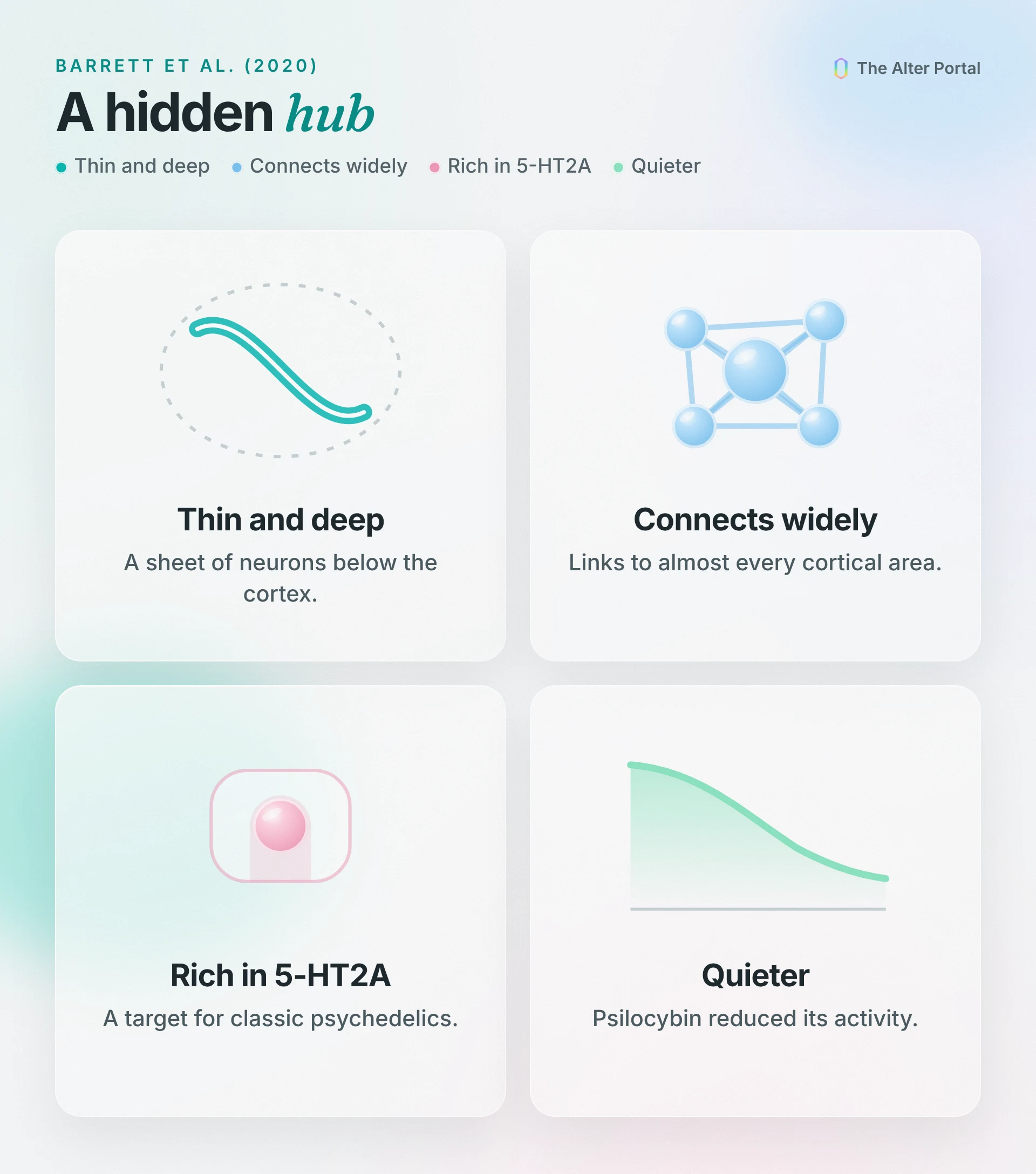
The claustrum is a thin sheet of neurons tucked deep beneath the cortex. Its name comes from the Latin for “hidden away”. Despite its size, it sends connections to almost every area of the cortex, and it is unusually rich in serotonin 2A receptors, the main target of classic psychedelics [1].
A hard place to study
Because it is so thin and deep, the claustrum is difficult to measure with brain scans. In 2020 Frederick Barrett and colleagues at Johns Hopkins used a method designed to isolate its signal and compared scans after psilocybin with scans after placebo [1].
What they saw
Psilocybin reduced the strength and variability of activity in both the left and right claustrum [1]. It also changed how the claustrum connected with large brain networks that support perception, memory and attention, including the default mode network [1].
Why people find it exciting
Some scientists have speculated that the claustrum helps bind experience together. If so, quietening it might be one piece of why psychedelic states can feel less unified or less centred on the self. That remains a hypothesis. This was a small imaging study, and the claustrum’s true job is still debated.
This article is educational. It is not medical advice and does not encourage anyone to take any drug.
The Alter Portal covers research and culture. Nothing here is medical advice or encouragement to use drugs. Read on the interactive site →