Why scientists gave MDMA to octopuses
Octopuses are usually loners. A 2018 experiment found that MDMA made them seek each other out, and the reason points back 500 million years.
 By Marlin Charmil · · 5 min read
Octopuses are clever, but they are not known for being sociable. That made them an interesting test for an old question: is the link between serotonin and social behaviour something mammals invented, or is it far older?
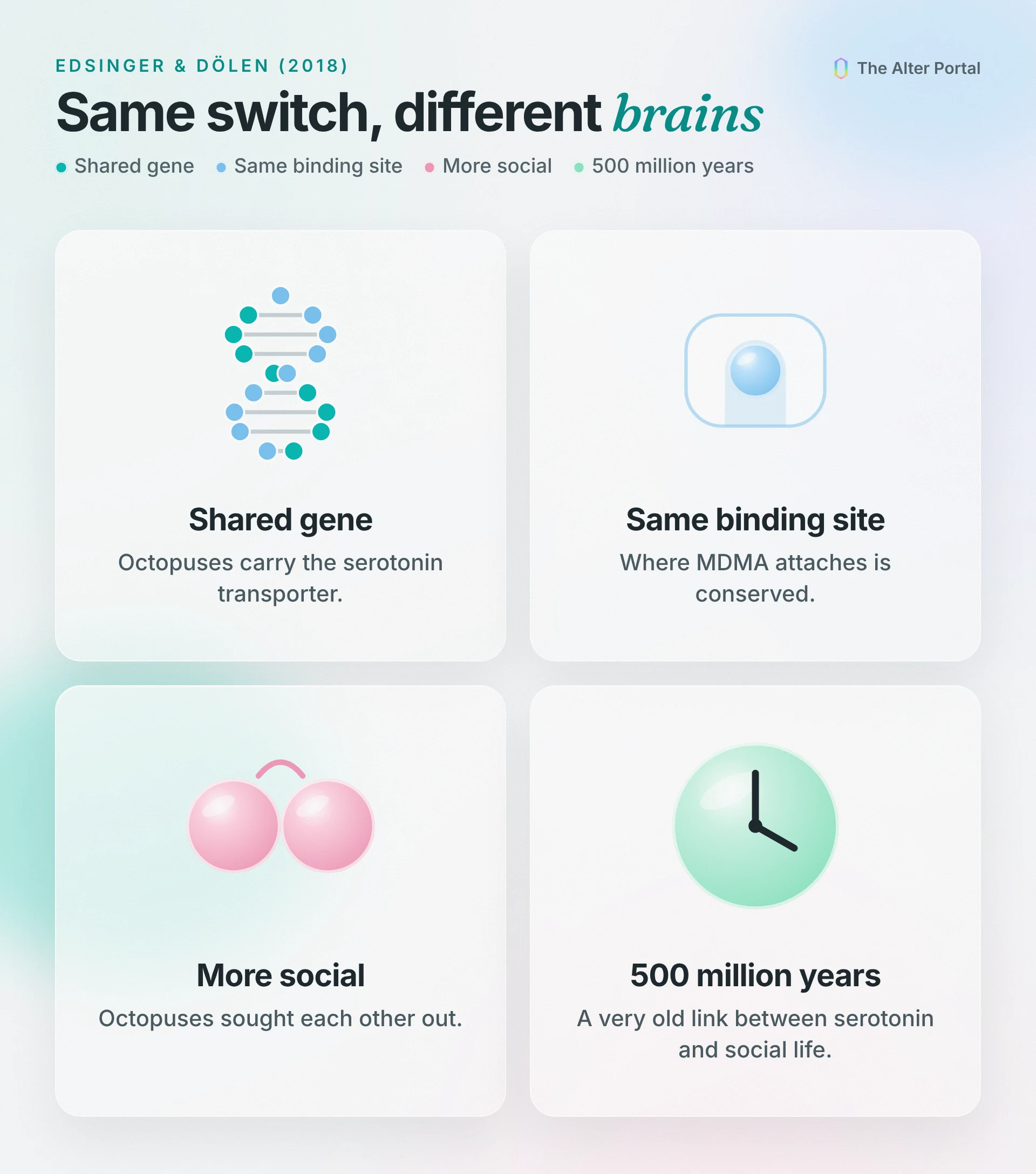
In 2018 Gül Dölen of Johns Hopkins and Eric Edsinger of the Marine Biological Laboratory looked inside the genome of the California two-spot octopus [1]. They found clear octopus versions of the human serotonin transporter gene, including the binding site that MDMA uses [1].
The experiment
They then built a simple test tank to measure how much time an octopus spent near another octopus. After exposure to MDMA, the animals showed more social approach behaviour [1].
Why it matters
Humans and octopuses split from a common ancestor about 500 million years ago. The researchers argue that serotonin has been helping to regulate social behaviour since at least then [2]. Brains can look completely different and still share the same molecular switches.
A note on limits
This was a small animal study of one species, and “more time near another octopus” is a narrow measure of sociability. Still, it is a striking example of how psychedelic-adjacent drugs can be used as tools to ask deep questions about evolution.
This article is educational. It is not medical advice and does not encourage anyone to take any drug.
The Alter Portal covers research and culture. Nothing here is medical advice or encouragement to use drugs. Read on the interactive site →