Do psychedelics cause mental illness? What population data say
A 135,000-person US survey found no link between lifetime psychedelic use and later mental health problems. Here is what that does and does not tell us.
 By Marlin Charmil · · 5 min read
One of the oldest fears about psychedelics is that they cause lasting mental illness. Clinical trials screen people carefully, so they cannot easily answer this. Large population surveys can help.
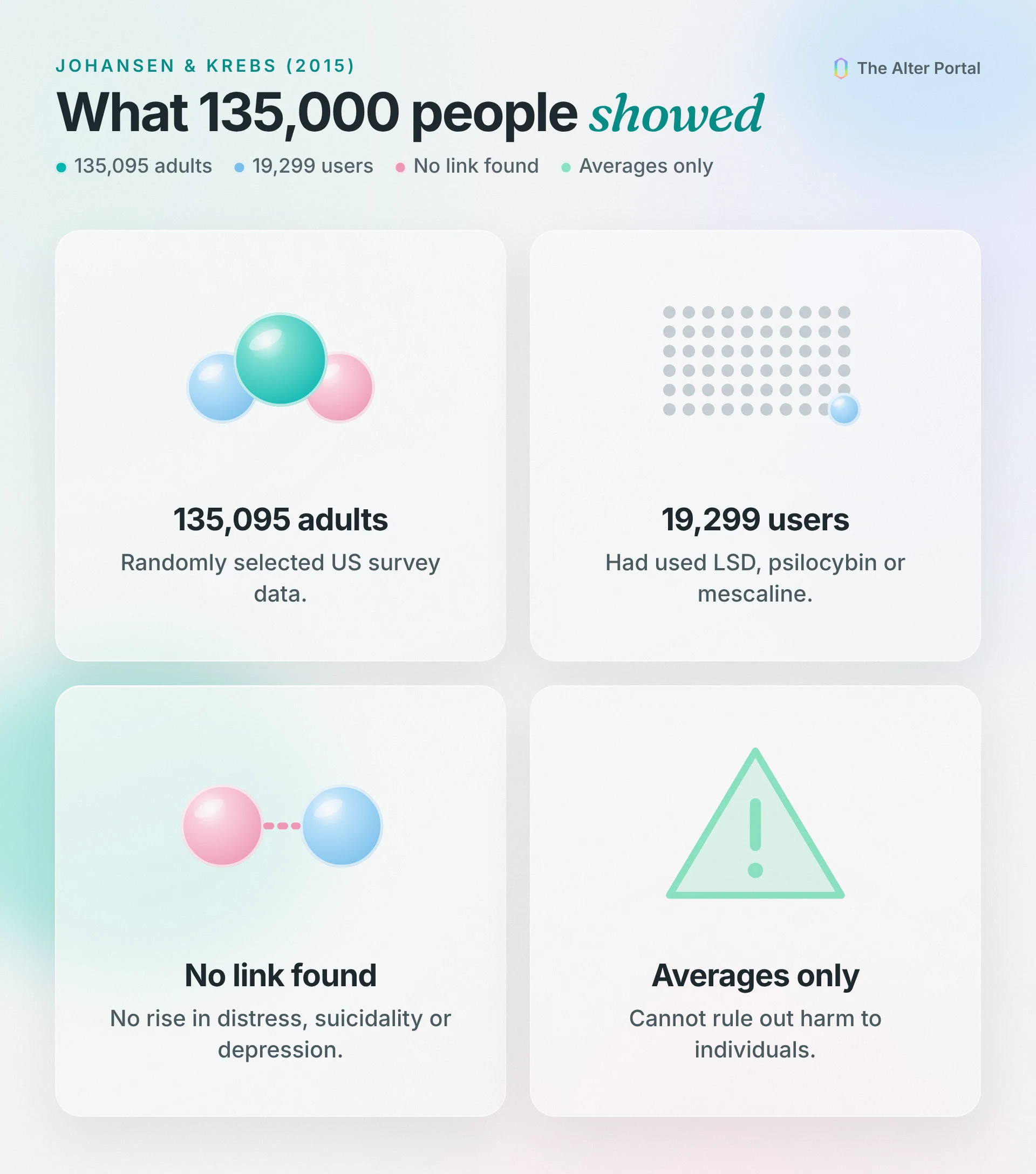
In 2015 Pål-Ørjan Johansen and Teri Krebs analysed data from 135,095 randomly selected US adults, including 19,299 who had used psychedelics such as LSD, psilocybin or mescaline [1].
The finding
After adjusting for age, other drug use, childhood depression and other factors, they found no significant link between lifetime psychedelic use and a higher chance of serious psychological distress, mental health treatment, suicidal thoughts, plans or attempts, depression or anxiety in the past year [1]. The authors concluded that psychedelic use did not appear to be an independent risk factor for these problems [1].
The limits of surveys
This is reassuring at the population level, but it is not a guarantee for any individual. Surveys rely on self-report and cannot show cause and effect. A small group of people may be harmed even if averages look flat, and people with a personal or family history of psychosis or bipolar disorder may face different risks. Our article on family history and psychosis looks at that question.
This article is educational. It is not medical advice and does not encourage anyone to take any drug.
The Alter Portal covers research and culture. Nothing here is medical advice or encouragement to use drugs. Read on the interactive site →