Does the brain make its own DMT?
Claims that the pineal gland floods us with DMT are everywhere online. A 2019 rat study gave the first solid look at what is really there.
 By Marlin Charmil · · 5 min read
The idea that the brain produces its own DMT, often linked to the pineal gland and to dreams or death, is popular online. For a long time it was mostly speculation. The University of Michigan physiologist Jimo Borjigin started investigating after she found that a famous claim about the pineal gland was only a hypothesis [2].
What the 2019 study found
Her team, with Rick Strassman and others, looked for the two enzymes needed to make DMT. They found the gene transcripts for one of them in the cerebral cortex, pineal gland and choroid plexus of both rats and humans, and found the two enzymes working side by side in rat brain cells [1].
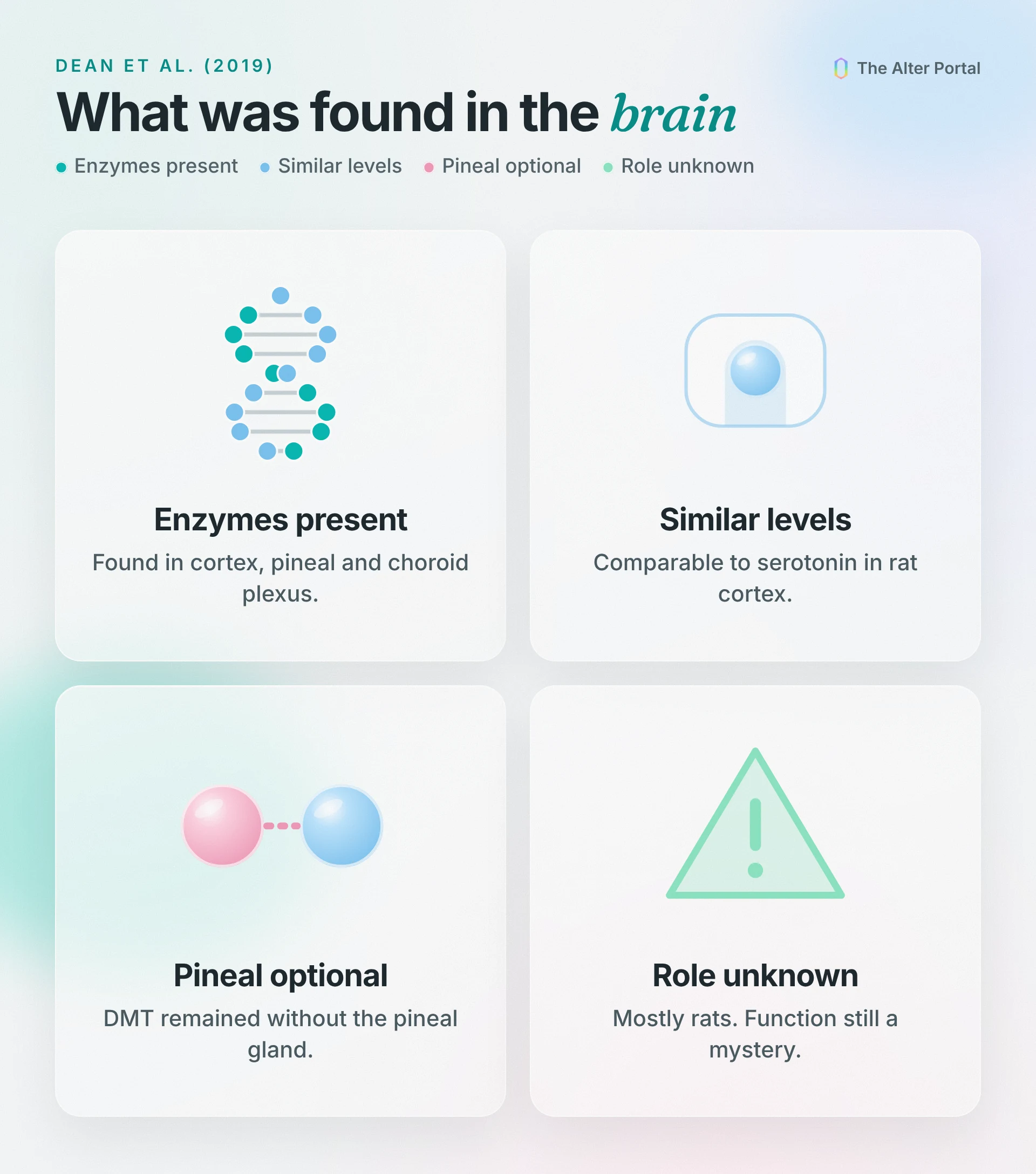
They also measured DMT directly in the brains of living rats. Levels outside cells in the cortex were similar to those of well-known messengers like serotonin, and this was true with or without a pineal gland [1]. After an induced cardiac arrest, DMT levels rose in the visual cortex of some rats [1].
What it does not show
This does not prove that human brains release enough DMT to cause visions, dreams or near-death experiences. Most measurements were in rats, and the function of natural DMT is still unknown. What it does show is that the pineal gland is not the whole story: if DMT has a role, it is spread more widely in the brain.
This article is educational. It is not medical advice and does not encourage anyone to take any drug.
The Alter Portal covers research and culture. Nothing here is medical advice or encouragement to use drugs. Read on the interactive site →