LSD makes waking imagery more dreamlike
Researchers asked people to imagine scenes while on LSD and scored how bizarre the stories were, using a measure built for dreams.
 By Marlin Charmil · · 5 min read
People often say psychedelic states feel “dreamlike”. In 2017 Rainer Kraehenmann and colleagues at the University of Zurich set out to measure that claim, rather than just describe it [1].
The design
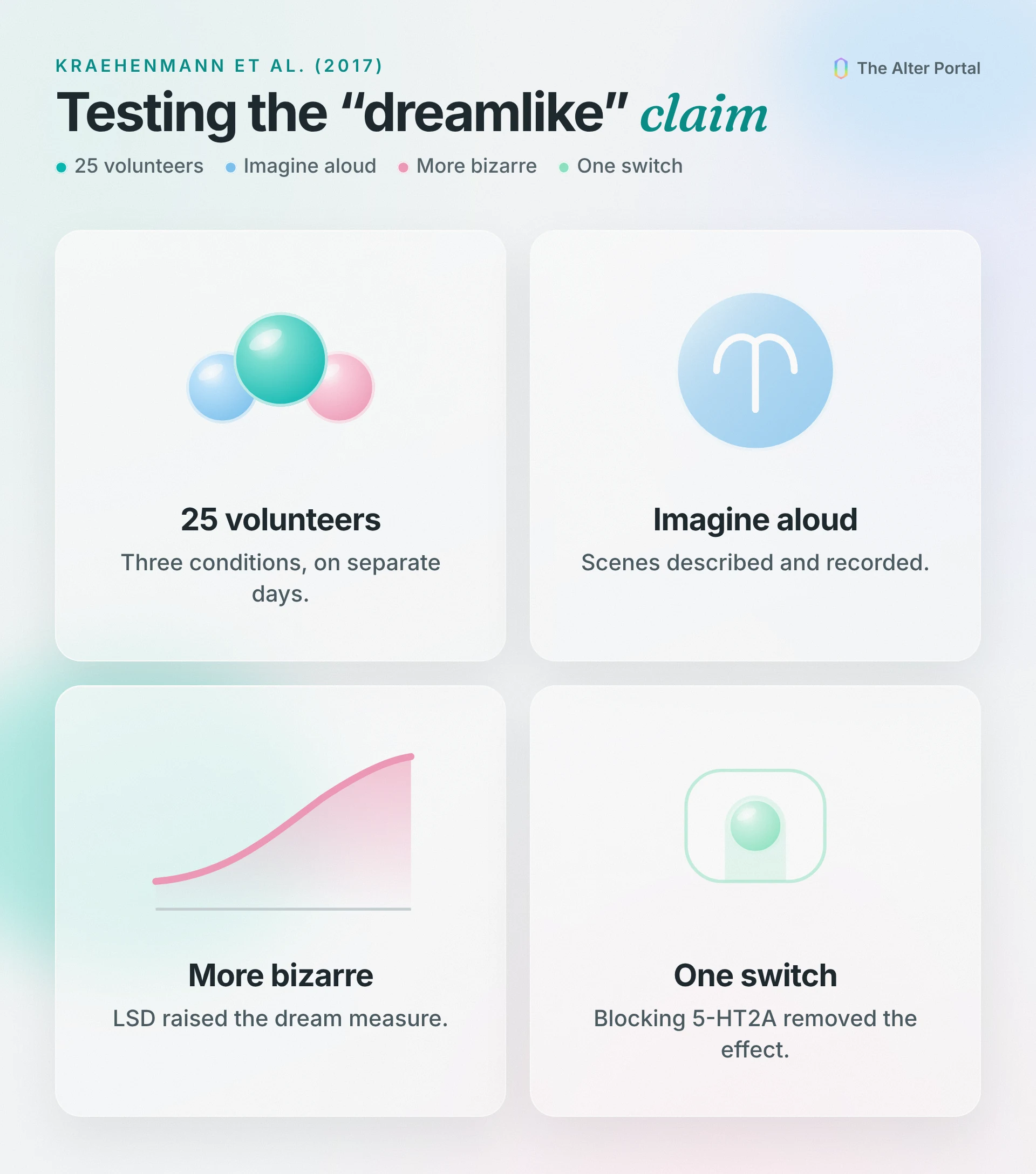
Twenty-five healthy volunteers took part in three conditions on different days: placebo, LSD, and LSD combined with ketanserin, a drug that blocks the serotonin 2A receptor [1]. Hours later, each person did a guided imagery task, describing scenes aloud. The recordings were scored for “cognitive bizarreness”, a formal measure researchers use to rate how dreamlike dream reports are [1].
What changed
Compared with placebo, LSD clearly increased cognitive bizarreness [1]. The more bizarre the imagery, the more people also reported a loss of self-boundaries and of cognitive control [1]. When ketanserin blocked the serotonin 2A receptor, both the dreamlike imagery and the change in consciousness disappeared [1].
Why it matters
The study gives a measurable link between psychedelic states and dreaming, and points to a single receptor as the switch. It does not mean an LSD experience is the same as a dream: people are awake, and many other things differ. But it is a neat example of how an everyday description can be turned into a testable claim.
This article is educational. It is not medical advice and does not encourage anyone to take any drug.
The Alter Portal covers research and culture. Nothing here is medical advice or encouragement to use drugs. Read on the interactive site →