Does DMT feel like dying? The near-death study
People who nearly die often describe tunnels, light and other realms. A 2018 study asked whether DMT produces the same kind of experience.
 By Marlin Charmil · · 5 min read
Near-death experiences, or NDEs, are vivid experiences reported by some people who come close to death. Common features include leaving the body, moving into another world, meeting presences and a deep sense of peace [2]. People who take DMT often describe very similar things.
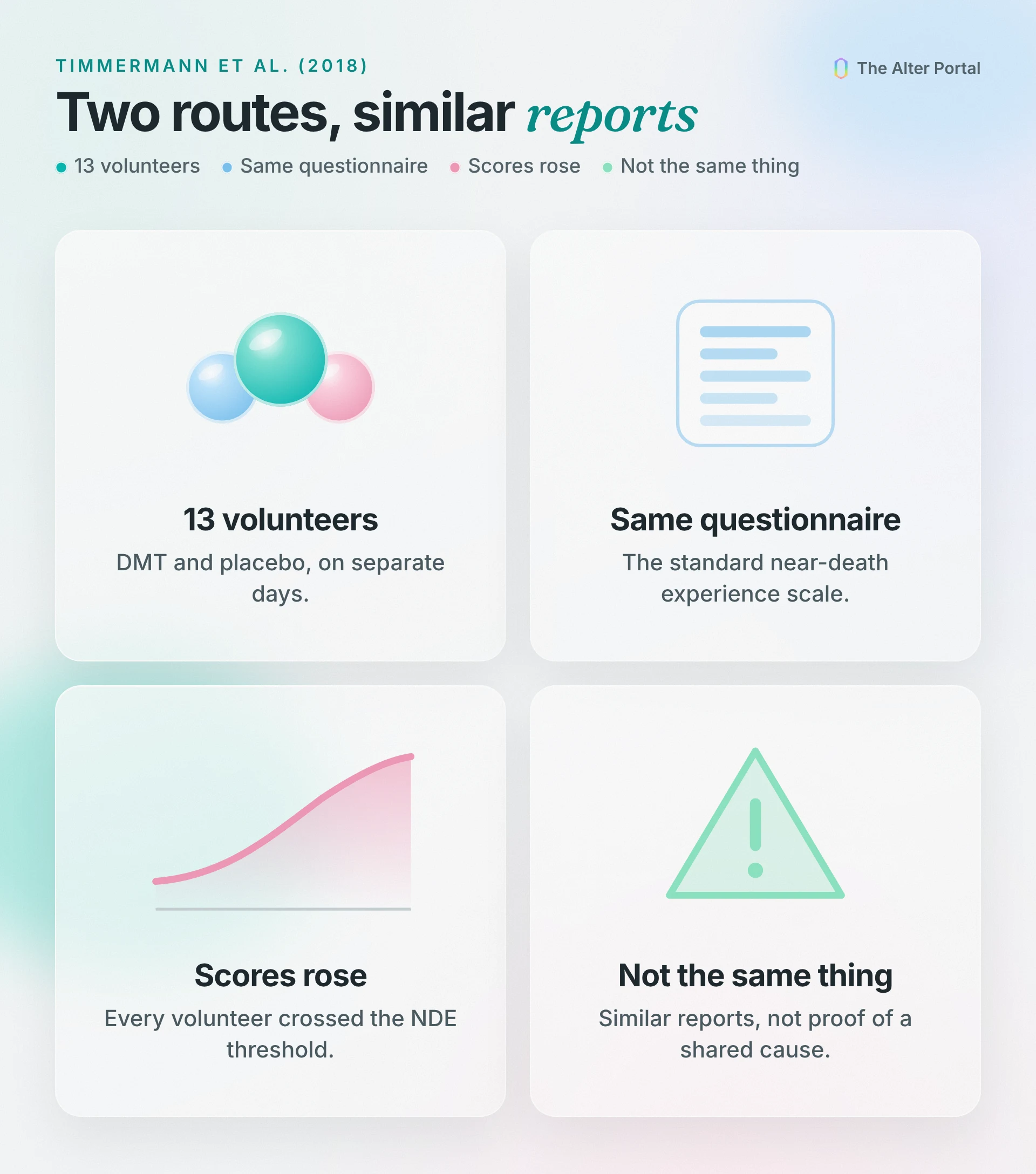
In 2018 Christopher Timmermann and colleagues at Imperial College London, working with near-death researchers in Liège, tested the overlap directly. They gave DMT and placebo to 13 healthy volunteers on separate days [1]. After each session, volunteers filled in a standard questionnaire used to measure near-death experiences [1].
What they found
DMT significantly increased scores on the near-death scale compared with placebo [1]. All volunteers scored above the threshold usually used to classify an experience as an NDE [2]. When the team compared the answers with those of people who had actually had near-death experiences, the overall pattern was strikingly similar [1].
What it does not mean
This does not show that DMT causes near-death experiences, or that the brain releases DMT when we die. It shows that two very different routes can lead to experiences people describe in similar ways. The sample was small, and filling in a questionnaire cannot capture everything about either state. But it opens a careful way to study one of the most mysterious experiences humans report.
This article is educational. It is not medical advice and does not encourage anyone to take any drug.
The Alter Portal covers research and culture. Nothing here is medical advice or encouragement to use drugs. Read on the interactive site →