Why time bends: what experiments show about psychedelics and time
“Time stopped” is one of the most common things people say about psychedelics. In the lab, the effect turns out to be specific, and surprisingly measurable.
 By Marlin Charmil · · 6 min read

Ask people to describe a psychedelic experience and many will say something about time: minutes that felt like hours, or a sense that time had stopped altogether. Feelings like that are hard to test. But how well someone can judge or reproduce a short interval is something you can measure with a stopwatch.
The psilocybin timing study
In 2007 Marc Wittmann, Franz Vollenweider and colleagues in Zurich ran a double-blind study of psilocybin and time [1]. Volunteers did three kinds of task: reproducing the length of a tone, tapping along to a regular beat, and tapping at whatever pace felt natural [1].
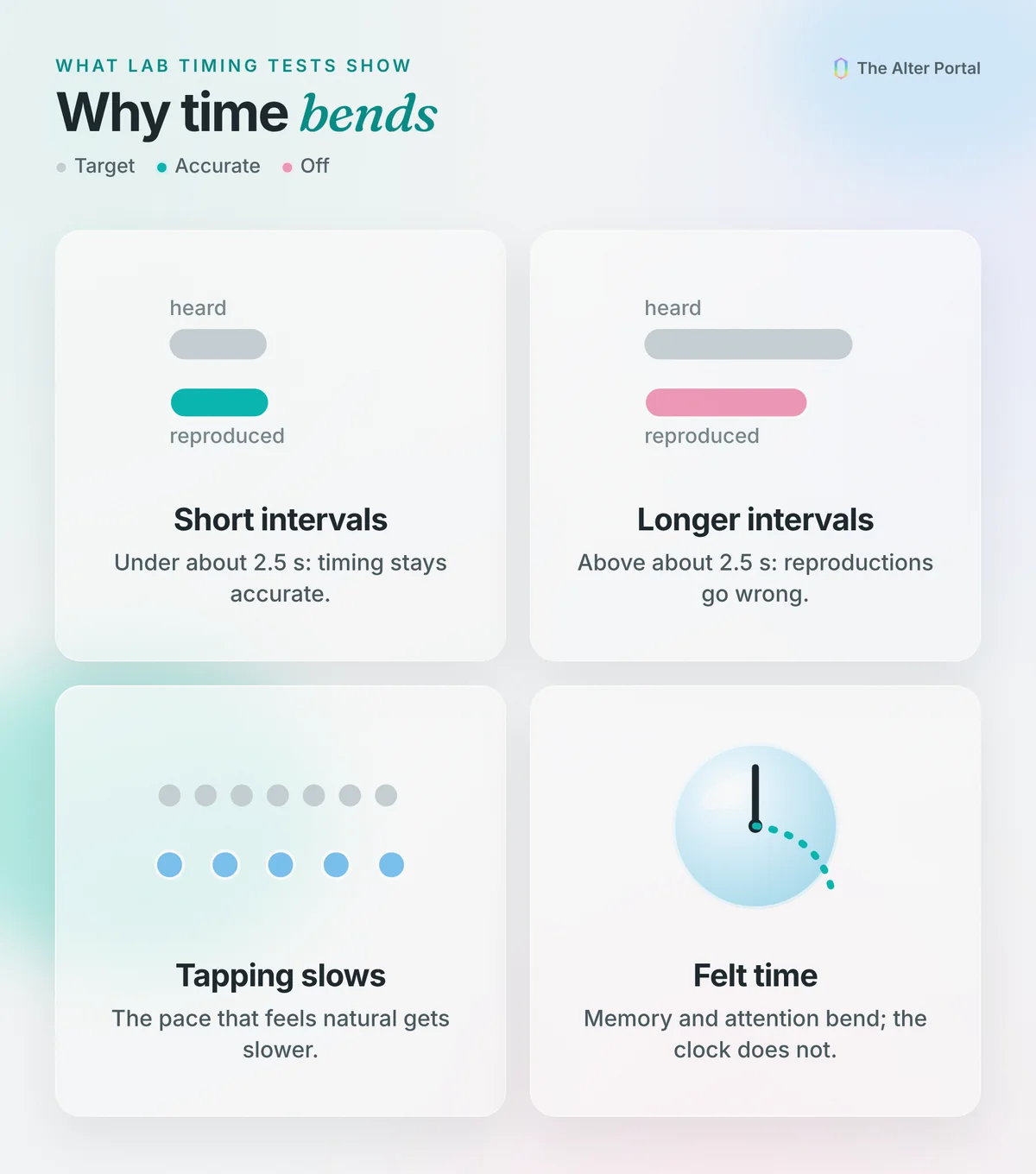
The results were strikingly selective. Psilocybin impaired people’s ability to reproduce intervals longer than about 2.5 seconds, while shorter intervals were largely unaffected [1]. It also made it harder to stay in sync with slower beats, and it slowed down the pace at which people preferred to tap [1]. The authors suggested that the drug disrupts the thinking parts of timing, such as holding an interval in working memory, rather than a basic internal clock [1].
Small doses, longer seconds
Later work with very small doses of LSD found a related pattern. In a 2019 study, people tended to over-reproduce intervals of two seconds and longer, holding the button down for longer than the time they had been shown [2]. This happened even though the volunteers reported few obvious effects from the drug [2].
Two kinds of time
Put together, these studies hint at a useful distinction. There is the split-second timing the brain uses to catch a ball or keep a beat, which seems fairly robust. And there is the longer, more reflective sense of time that relies on attention and memory. That second kind is where psychedelics appear to bend things, and perhaps why the felt sense of time can stretch so dramatically.
These are small laboratory studies, and lab tasks only capture a sliver of what people mean when they say time “dissolved”. But they show that even the strangest parts of an experience can sometimes be turned into careful, testable questions.
This article is educational. It is not medical advice and does not encourage anyone to take any drug.
The Alter Portal covers research and culture. Nothing here is medical advice or encouragement to use drugs. Read on the interactive site →