Mystical, emotional, challenging: three parts of an experience
For years, research focused on mystical-type experiences. A 2019 study argued that two other ingredients matter too, and that you need all three to predict what comes next.
 By Marlin Charmil · · 6 min read
When scientists try to work out why some people benefit from a psychedelic experience and others do not, they often look at what the experience itself was like. For a long time the star of that story was the “mystical-type” experience: a sense of unity, of timelessness, of something sacred.
That focus had good reasons. In a trial of psilocybin for treatment-resistant depression, people who had stronger mystical-type and “peak” experiences tended to do better afterwards [1]. But clinicians kept noticing something else in sessions, too: moments of raw emotional release.
Naming emotional breakthrough
In 2019 Leor Roseman and colleagues at Imperial College London set out to measure those moments [2]. They built a six-item questionnaire, the Emotional Breakthrough Inventory, with statements such as facing difficult feelings you usually push aside, or getting a sense of closure on an emotional problem [2]. Analysis showed that emotional breakthrough is a distinct part of the experience, not just another word for mysticism [2].
Three measures, one picture
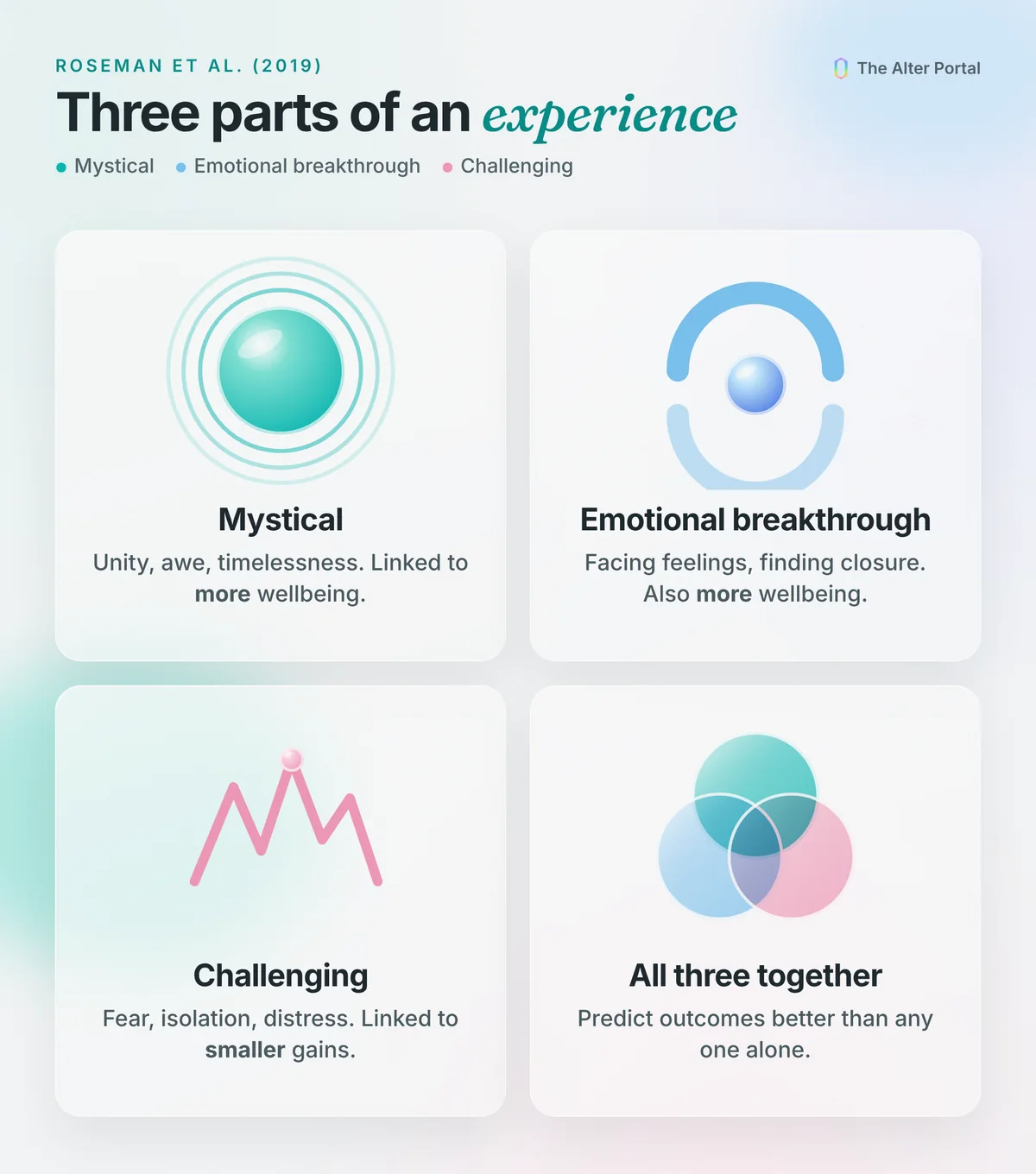
The team followed 379 people who filled in surveys before and after a planned psychedelic experience [2]. In those who started with low wellbeing, three measures together predicted how their wellbeing changed two weeks later [2]:
- Mystical-type experience predicted increases in wellbeing.
- Emotional breakthrough predicted increases too.
- Challenging experience, such as fear, isolation or distress, predicted smaller increases.
Crucially, each of the three added something of its own. A model with all three did better than any model that left one out [2].
What this suggests
The lesson is that a psychedelic experience is not one thing. It can be awe-filled, tearful and frightening in the same afternoon, and each of those threads may pull outcomes in a different direction. For research, it means measuring more than one dimension. For therapy, it means that supporting people through the emotional and difficult parts may matter as much as hoping for a mystical peak.
This was an online survey of self-selected people, not a controlled trial, so it shows associations rather than proof of cause.
This article is educational. It is not medical advice and does not encourage anyone to take any drug.
- Roseman, Nutt & Carhart-Harris (2018), Quality of acute psychedelic experience predicts therapeutic efficacy of psilocybin for treatment-resistant depression, Frontiers in Pharmacology
- Roseman et al. (2019), Emotional breakthrough and psychedelics: validation of the Emotional Breakthrough Inventory, Journal of Psychopharmacology
The Alter Portal covers research and culture. Nothing here is medical advice or encouragement to use drugs. Read on the interactive site →