Self, others, world: the three kinds of connection
People coming out of psychedelic therapy often say they feel “connected” again. Researchers have tried to pin down what that actually means.
 By Marlin Charmil · · 6 min read
If you read interviews with people who have been through psilocybin therapy, one word comes up again and again: connection. Not a mystical vision, not a new idea, but a feeling of being joined back up.
In 2017 the psychologist Rosalind Watts and colleagues at Imperial College London interviewed 20 people six months after they took part in an early psilocybin trial for treatment-resistant depression [1]. Two big shifts stood out. One was a move from disconnection to connection, to themselves, to other people and to the world. The other was a move from avoiding emotions to accepting them [1]. Several patients said that earlier treatments had tended to deepen the sense of being cut off, while the psilocybin treatment did the opposite [1].
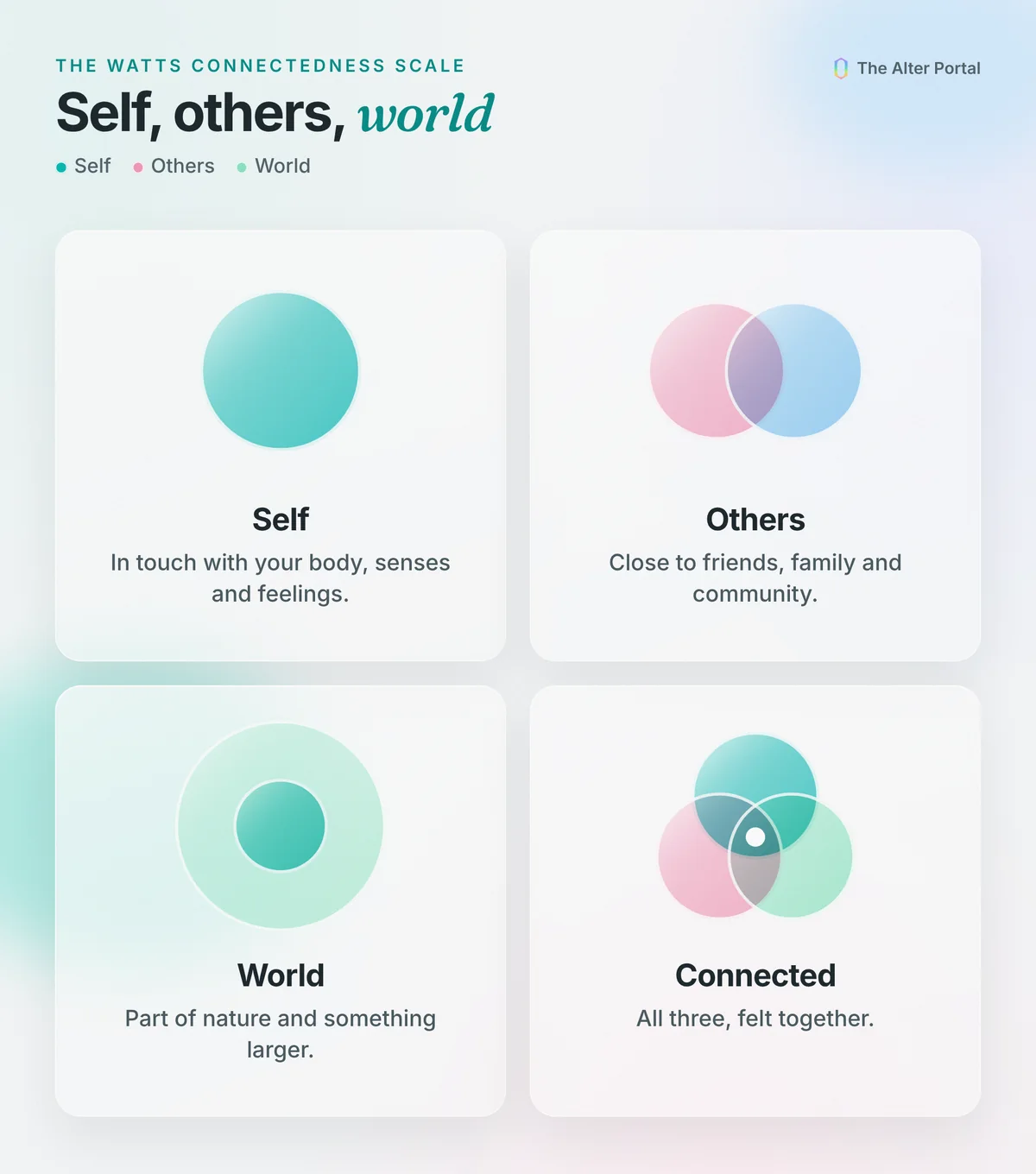
Giving the feeling a shape
Words from interviews are rich but hard to compare. So in 2022 the same group built a questionnaire, the Watts Connectedness Scale. They defined connectedness simply as “a state of feeling connected to self, others and the wider world” [2].
- Self: being in touch with your own senses, body and emotions.
- Others: feeling close to friends, family and community.
- World: feeling part of nature, the living world and something larger.
Earlier scales tended to measure just one of these, for example social connectedness or nature connectedness. The idea here is that they are different faces of one shared feeling [2].
What the numbers showed
The team tested the scale on more than 1,200 people who filled it in before and after a planned psychedelic experience, and in a clinical trial comparing psilocybin with the antidepressant escitalopram [2]. The three parts held together as expected, and connectedness scores rose after psychedelic use, both overall and on each of the three parts [2]. Increases in connectedness also tracked improvements in mental health [2].
What it does not tell us
Most of the survey data came from people who chose to take psychedelics and chose to fill in the questionnaire, so they are not a random slice of the population. And feeling more connected is a report of experience, not a brain scan. Still, the scale gives researchers a shared language for something patients had been describing all along: that part of getting better is feeling part of things again.
This article is educational. It is not medical advice and does not encourage anyone to take any drug.
The Alter Portal covers research and culture. Nothing here is medical advice or encouragement to use drugs. Read on the interactive site →