The afterglow: what lingers in the weeks after
Researchers have long noticed a strange window after a psychedelic experience, when mood lifts and old worries loosen. Only recently have they tried to measure it.
 By Marlin Charmil · · 6 min read
Most drugs leave you with a hangover, if anything. Classic psychedelics are unusual because people often report the opposite: a few days or weeks in which they feel lighter, calmer and more open. In the 1960s this was given a name, the “afterglow” [1].
The psychiatrist Walter Pahnke and colleagues described it as a period in which “mood is elevated and energetic”, with a relative freedom from concerns of the past, from guilt and from anxiety [1]. They noted that it could last from two weeks to a month and then gradually fade into vivid memories [1].
Three windows, not one
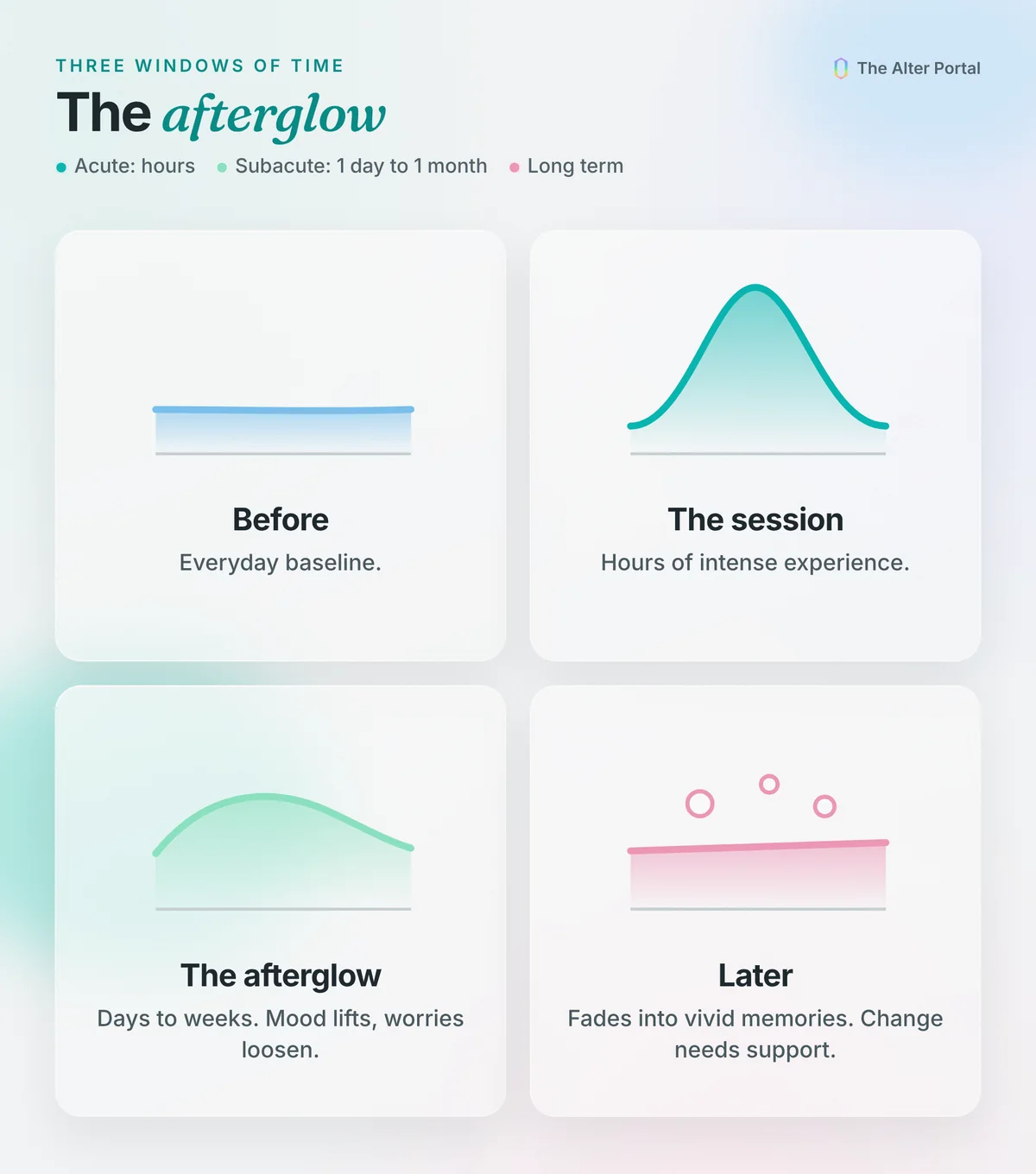
It helps to picture three separate windows. First, the acute experience itself, which lasts hours. Second, the subacute window, from roughly a day to a month afterwards, where the afterglow sits. Third, the long-term changes that some people report months later. A 2015 review by Tomislav Majić and colleagues argued that therapy might make use of each window differently, and that the afterglow could be a period when people are especially open to change [2].
What the studies found
In 2023 a systematic review pulled together 48 studies with 1,774 participants that looked at effects between one day and one month after classic psychedelic use [1]. Across them, the authors found reductions in various symptoms and increases in wellbeing, mood, mindfulness, social measures and spirituality, though some findings were mixed [1]. They also noted that, until then, descriptions of the afterglow had relied mainly on individual case reports [1].
To measure it properly, the same research network built a 24-item questionnaire, the Afterglow Inventory, using an online survey of more than 1,300 people who had recently taken a psychedelic and 157 people who had taken something else [3]. The final version could tell the two groups apart [3].
A window, not a cure
The afterglow is temporary, and not everyone has one. Its main interest for researchers is as a possible window: a short period when new habits, insights and conversations might take root more easily, if there is support around the person. That is one reason why trials put so much weight on the sessions that come after the drug, not just the drug itself.
This article is educational. It is not medical advice and does not encourage anyone to take any drug.
- Majić, Schmidt & Gallinat (2015), Peak experiences and the afterglow phenomenon, Journal of Psychopharmacology
- Evens et al. (2023), The psychedelic afterglow phenomenon: a systematic review of subacute effects, Therapeutic Advances in Psychopharmacology
- Majić et al. (2025), The Afterglow Inventory (AGI), Journal of Psychopharmacology
The Alter Portal covers research and culture. Nothing here is medical advice or encouragement to use drugs. Read on the interactive site →