Four doors into the mind: how “psychedelics” differ by the switch they flip
Psilocybin, ketamine, MDMA and salvia are often lumped together. Inside the brain they work in four very different ways.
 By Marlin Charmil · · 7 min read
In headlines, “psychedelic” has become a catch-all word. It gets used for magic mushrooms, for ketamine clinics, for MDMA therapy and even for a Mexican sage. That is a bit like calling every key on your keyring “the house key”. They all open something, but not the same door.
Pharmacologists sort these substances by what they do at the level of molecules: which receptor they touch, and whether they switch it on, block it, or flood the system with a chemical messenger. Seen that way, there are at least four quite separate families.
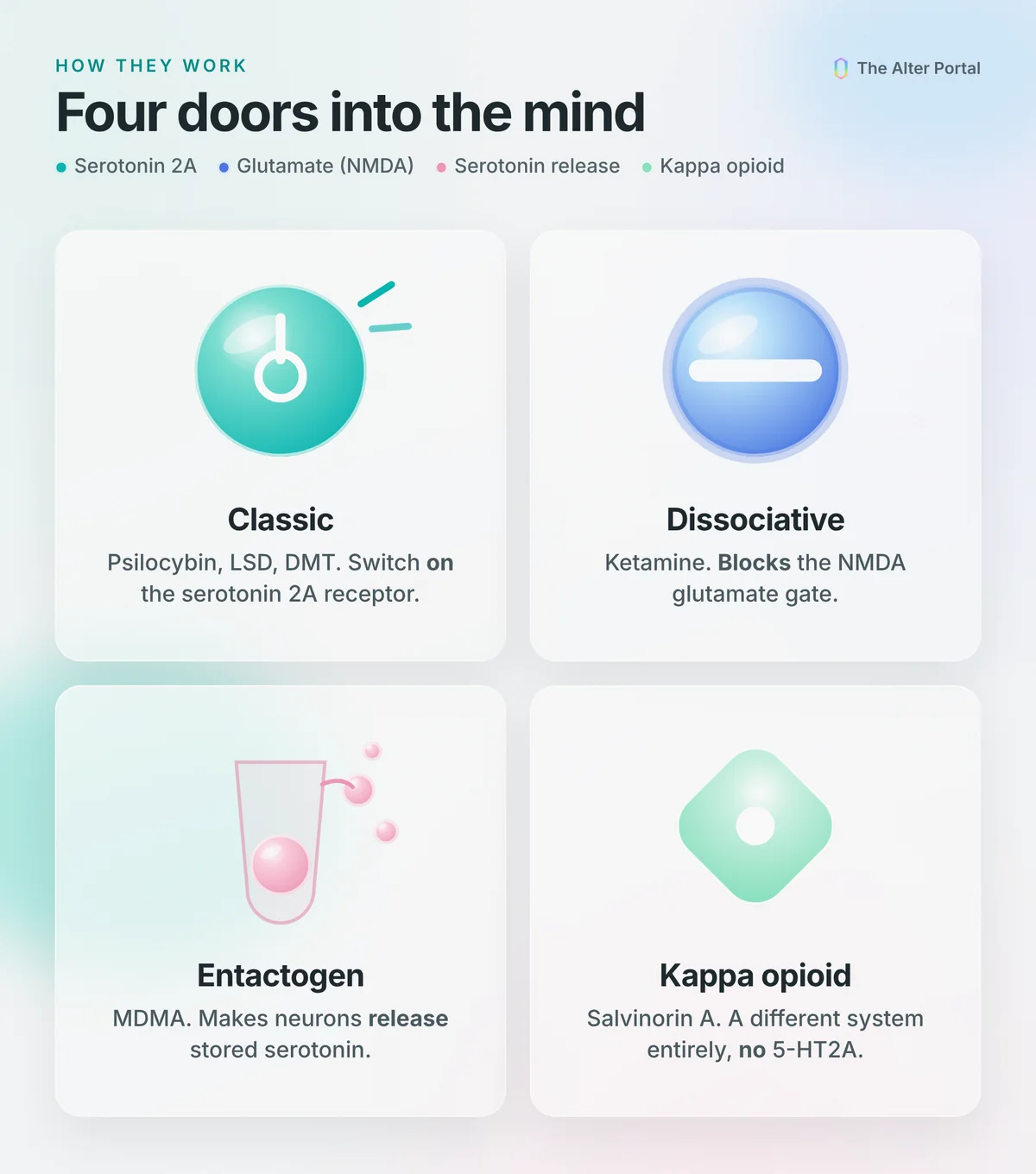
1. The classic psychedelics: switching on 5-HT2A
Psilocybin, LSD, DMT and mescaline are the “classic” psychedelics. There is now a broad consensus that they work as agonists or partial agonists at the serotonin 2A receptor, especially on large cells deep in the outer layer of the cortex [1]. In plain terms: they fit a particular serotonin lock and turn it. Block that receptor in experiments and most of the classic psychedelic effects disappear.
2. The dissociatives: blocking a glutamate gate
Ketamine looks like a psychedelic from the outside, because it can bend perception and the sense of self. But its main action is the opposite kind of move. Ketamine is a non-competitive antagonist at NMDA receptors, a gate for the brain’s main excitatory messenger, glutamate [2]. It was first studied in psychiatry as a way of modelling psychosis, and only later as a fast-acting antidepressant [2]. Some researchers now call it an “atypical psychedelic”, while still stressing that its route is different [3].
3. The entactogens: opening the serotonin floodgates
MDMA was given its own category in 1986, when the chemist David Nichols proposed the word “entactogen”, roughly “touching within”, because it did not fit neatly as either a hallucinogen or a stimulant [4]. Rather than mainly switching on one receptor, MDMA is carried into neurons by the serotonin transporter and makes them release their stored serotonin [4]. Experiments in the early 1990s showed this transporter-driven release directly [5].
4. The odd one out: kappa opioid
Salvia divinorum was a puzzle for decades. In 2002 Bryan Roth and colleagues showed that its active compound, salvinorin A, is a potent and selective agonist at the kappa opioid receptor, and that it had no action at the serotonin 2A receptor at all [6]. It was the first known naturally occurring opioid-receptor drug that is not an alkaloid [6]. In other words, a vivid “psychedelic” experience can come from a completely different chemical system.
Why the sorting matters
These differences are not just trivia. Different mechanisms mean different risks, different interactions with medicines and different reasons a treatment might or might not work. A finding about psilocybin cannot simply be copied across to ketamine or MDMA. When you next see the word “psychedelic” in a headline, it is worth asking: which door, and which switch?
This article is educational. It is not medical advice and does not encourage anyone to take any drug.
- Nichols (2016), Psychedelics, Pharmacological Reviews
- Cabrera Abreu et al. (2025), From model psychosis to rapid antidepressant: a review of ketamine’s psychiatric history
- Marguilho et al. (2023), A unified model of ketamine’s dissociative and psychedelic properties, Journal of Psychopharmacology
- Nichols (2022), Entactogens: how the name for a novel class of psychoactive agents originated, Frontiers in Psychiatry
- Rudnick & Wall (1992), The molecular mechanism of “ecstasy”, PNAS
- Roth et al. (2002), Salvinorin A: a potent naturally occurring nonnitrogenous κ opioid selective agonist, PNAS
The Alter Portal covers research and culture. Nothing here is medical advice or encouragement to use drugs. Read on the interactive site →